Chapter 6 - The C++ Standard Library
The C++ Standard Library
6.1 General
- STL, standardised together with C++ language autumn 1998
- C++17 2017
- Cotain most important basic data structures and algorithms
- contains
- Inputs/output ,cin,cout..
- processing character strings
- minimum,maimum
- search / modifying operations of queues
- support for functional programming
- complex number
- arithmetic fnctions
- vector arithmetrics and support for matrix
- Lambdas , C++ 11
- Generic algorithms with iterators
6.2 Iterators
- STL data structures as black boxes with a lot of common characteristics
- They contain the elements we have stored in them
- They implement a certain set of interface functions
- We can only handle the contents of the containers through
- the interface functions
- the iterator

- Each iterator points to
- the begining or the end of the data structure
- between two elements
- The element on the right side of the iterator can be accessed through it
- except if the question is a reverse iterator which is used to access the element on the left side
- The operations of moving the reverse iterator work in reverse, ++i, moves iterator on step to the left (i++時,iterator正路右行,但reverse iterator就向左行)
- The container can invoke the iterators poinitng to the beginning and the end of the container by
container.begin(), container.end() container.rbegin(), container.rend()return the reverse iterators- An iterators can be used
- reading or writing
- iterate over the elements of the container
Each Container has its own iterator type
- different containers provide different possibilities of moving the iterator from one place to another efficiently
- iterators can be divided into categories based on which constant time operations they are able to provide
Input Iterator
- read elements values but not change them
*p(read the value by dereferencing iterator p )p->firstp->second(a field of the element the itertaor points to can be read or its memeber function can be called)++p / p++move one step forwardp=q, p==q, p!=qassign/ compare
output iterator
- An output iterator is like an input iterator but it can be used only to change the elements (*p=x)
forward iterator
- A forwaed iterator is a combination of the interfaces of the input and output iterators
bidirectional iterator
A bidirectional iterator is able to move one step at a time backwards(–p or p–)
random access iterator
A random access iterator is like a bidirectional iterator but it can be moved an arbitrary amount of steps forwards or backwards.
6.3 Containers
-
Two types of container
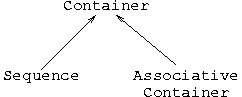
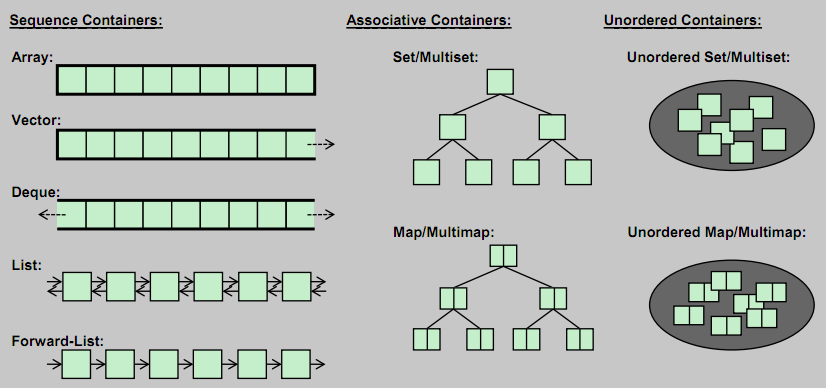
- sequences
- can be searched based on their number in the container a[0],a[1]
- Can be added and removed at the desired location
- can be scanned based on their order
- array,vector,deque,list,forward_list
- associative containers
- elements placed in the container to the location determined by their key
- operator < can be used to compare the key values of elements in the ordered containers
- map, set, unordered_map, unordered_set
- sequences
-
Adapters : Queue Stack
-
Containers are passed by value
- It takes a copy of the data stroed in it and returns copies of the data it contains
- Elements stored into the containers must implement a copy constructor and an assignment operator
- Elements of a type defined by the user should be stored with a pointer pointing to them(efficiency)
  std::shared_ptr<int> foo = std::make_shared<int> (10);
  std::cout << "*foo: " << *foo << '\n'; //(*foo: 10)

Sequence container
Array
template < class T, size_t N >
class array;
//Initialization
array<int, 3> a = {1, 2, 3};

array<int, 100> b = {1, 2, 3};  // a[0] ~ a[2] = 1, 2, 3; a[3] ~ a[99] = 0, 0, 0 ... 0;

array<int, 3> c; //c[0]~c[2] not yet initialized
Array<int , 10> array
array.size();
array.max_size();
array.at(0);
array[0];
array.front();
array.back();

//Modifier
array.fill(5); //fill the array with the value 5
array.swap(array2) //swap the value with another array
Vector
template < class T, class Alloc = allocator<T> >
class vector; // generic template
//Initialization
  std::vector<int> first;                                // empty vector of ints
  std::vector<int> second (4,100);                       // four ints with value 100
  std::vector<int> third (second.begin(),second.end());  // iterating through second
  std::vector<int> fourth (third);                       // a copy of third

// Constant time Indexing .at(),[]
// Constant time addition push_back() and removel pop_back()
// Linear time Insertion with insert() and removal erase() O(n)
// emplace_back(args) build the element directly into the vector
// Size can ce increased by .resize(size, initial_val)
Iterators invalidated when
- Insertion
- All iterators which point to an element before the point of insertion are unaffected but all others are invalidated.
- If the size is larger due to insertion, all iterators get invalidated .
- Removal
- Every iterator and reference after the point of erasing is invalidated.
Deque
template < class T, class Alloc = allocator<T> >
class deque;
 std::deque<int> first;                                // empty deque of ints
  std::deque<int> second (4,100);                       // four ints with value 100
  std::deque<int> third (second.begin(),second.end());  // iterating through second
  std::deque<int> fourth (third);

//Amortized running-time of adddition and removal at both ends
second.push_front(val);
second.emplace_front(args);
second.pop_front();
Iterators invalidated when
- Insertion
- All iterators and references are invalidated
- unless the inserted member is at an end (front or back) of the deque
- all iterators are invalidated, but references to elements are unaffected
- unless the inserted member is at an end (front or back) of the deque
- All iterators and references are invalidated
- Removal
- All iterators and references are invalidated
- unless the erased members are at an end (front or back) of the deque
- only iterators and references to the erased members are invalidated
List
template < class T, class Alloc = allocator<T> >
class list;

//Constructor
  std::list<int> first;                                // empty list of ints
  std::list<int> second (4,100);                       // four ints with value 100
  std::list<int> third (second.begin(),second.end());  // iterating through second
  std::list<int> fourth (third);                       // a copy of third

// Constant time in Addition and Removal
// Addition and Removal do not invalidate the iterators or references (except naturally to elements removed)

//transfer the element from list to list
list1.splice(location, list2) // makes the other list a part of the second list in front of the location
list1.splice(location, list2, val) // moves an element from another list or the same list in front of the location
Amortized running time(攤分運作時間)
-
Insert 11 |11| +--+ +--+--+ Insert 12 |11|12| +--+--+ +--+--+--+--+ Insert 13 |11|12|13| | +--+--+--+--+ +--+--+--+--+ Insert 14 |11|12|13|14| +--+--+--+--+ +--+--+--+--+--+--+--+--+ Insert 15 |11|12|13|14|15| | | | +--+--+--+--+--+--+--+--+ -
When insert 12, 15 , the arraysize has been doubled.
- it taks O(n) to create a double-size array and do a copy the old value to the new array
- Otherwise, it takes O(1) times to do the insertion
-
The average operation time is $\frac{nO(1)+O(n)}{n+1}$ , which is a constant.
- each size addition operation that requires expensive memory allocation is preceded by an amount of inexpensive additions relative to the price of the expensive operation(在expensive additon 操作之前都經歷過很多inexpensive addtion)
- the cost of the expensive operation can be equally divided to the inexpensive operations
- now the inexpensive operation are still constant time
- the savings can be used to pay for the expensive operation
Associative container
set and multiset
-
Can be Searched added and delted in logarithmic time $\Theta(logn)$
-
Can be Scanned in ascending order in amortized constant time. $\Theta(1)$
-
Scan from the beginning to the end is alwasy in a linear time $\Theta( n )$
-
The same element can be in the multiset several times
-
In the set elements are unique
-
Chaning the value of the element directly has been prohibited
- The old element needs to be removed and new one added instead(先刪除舊元素後增加新元素,不能直接改變)
template < class T,                        // set::key_type/value_type
           class Compare = less<T>,        // set::key_compare/value_compare
           class Alloc = allocator<T>      // set::allocator_type
           > class set;

//Constructor
 std::set<int> first;                           // empty set of ints

  int myints[]= {10,20,30,40,50};
  std::set<int> second (myints,myints+5);        // range

  std::set<int> third (second);                  // a copy of second

  std::set<int> fourth (second.begin(), second.end());  // iterator ctor.

  std::set<int,classcomp> fifth;                 // class as Compare

  bool(*fn_pt)(int,int) = fncomp;
  std::set<int,bool(*)(int,int)> sixth (fn_pt);  // function pointer as Compare

.find(val)  //Get iterator to element (public member function )
.lower_bound(val)  finds the first element ≥ element
.upper_bound(val) finds the first element > element
map and multimap
- the type of the pair is pari<T1,T2>
- a pair can be created by make_pair
- .first() .second()
template < class Key,                                     // map::key_type
           class T,                                       // map::mapped_type
           class Compare = less<Key>,                     // map::key_compare
           class Alloc = allocator<pair<const Key,T> >    // map::allocator_type
           > class map;

the type is a pair
typedef pair<const Key, T> value_type;
 foo = std::make_pair (10,20);

bool fncomp (char lhs, char rhs) {return lhs<rhs;}

struct classcomp {
  bool operator() (const char& lhs, const char& rhs) const
  {return lhs<rhs;}
};

std::map<char,int> first;

  first['a']=10;
  first['b']=30;
  first['c']=50;
  first['d']=70;

  std::map<char,int> second (first.begin(),first.end());
  std::map<char,int> third (second);
  std::map<char,int,classcomp> fourth;                 // class as Compare

  bool(*fn_pt)(char,char) = fncomp;
  std::map<char,int,bool(*)(char,char)> fifth (fn_pt); // function pointer as Compare

  return 0;
Hash Tables
-
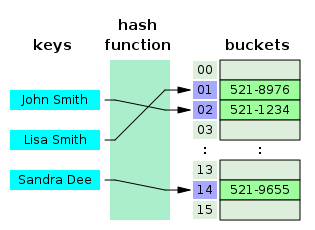
Unordered Set and Multiset is a structure hat containts a set of elements and unodered map/multimap contains a set of key-value pairs.
- The elements are not ordered
- Addition, Removal, and searching is on average constant time
- worst case is linear time
- The size of hash table is automatically increased
- because it has to keep the load factor
- the number of keys stored in the hash table divided by the capacity
Stack

template <class T, class Container = deque<T> > class stack;

  std::deque<int> mydeque (3,100);          // deque with 3 elements
  std::vector<int> myvector (2,200);        // vector with 2 elements

  std::stack<int> first;                    // empty stack
  std::stack<int> second (mydeque);         // stack initialized to copy of deque

  std::stack<int,std::vector<int> > third;  // empty stack using vector
  std::stack<int,std::vector<int> > fourth (myvector);

stack.size();
stack.top();
stack.push(val);
stack.pop();
stack.empty()
Queue
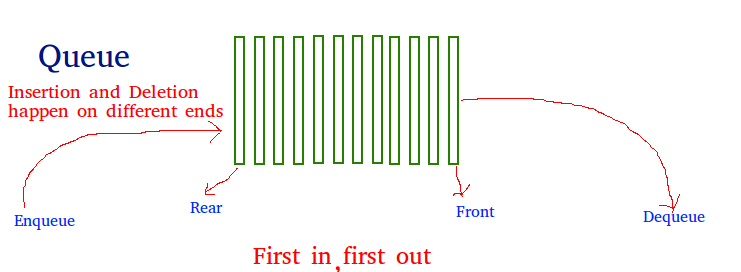
template <class T, class Container = deque<T> >
class queue;

  std::deque<int> mydeck (3,100);        // deque with 3 elements
  std::list<int> mylist (2,200);         // list with 2 elements

  std::queue<int> first;                 // empty queue
  std::queue<int> second (mydeck);       // queue initialized to copy of deque

  std::queue<int,std::list<int> > third; // empty queue with list as underlying container
  std::queue<int,std::list<int> > fourth (mylist);
Priority_Queue
- identical interface as queue
- implemented with a heap
- top() returns the largest
template <class T, class Container = vector<T>,
class Compare = less<typename Container::value_type> >
class priority_queue;

class mycomparison
{
  bool reverse;
public:
  mycomparison(const bool& revparam=false)
    {reverse=revparam;}
  bool operator() (const int& lhs, const int&rhs) const
  {
    if (reverse) return (lhs>rhs);
    else return (lhs<rhs);
  }
};

int main ()
{
  int myints[]= {10,60,50,20};

  std::priority_queue<int> first;
  std::priority_queue<int> second (myints,myints+4);
  std::priority_queue<int, std::vector<int>, std::greater<int> >
                            third (myints,myints+4);
  // using mycomparison:
  typedef std::priority_queue<int,std::vector<int>,mycomparison> mypq_type;
6.4 Generic Algorithm
- All algorithms have been implemented with function templates that get all the necessary information about the containers through their parametres
- The container are not passed directly as a paramount to the algorithm
- iterators to the containers are passed
- parts of container can be handled
- The standard library algorithm are in $algorithm$
- The standard defines the C-language libray $cstdlib$
Binary Search
- binary_search(first, end, value) return boolean
Sorting Algorithms
- sort(beg,end) and stable_sort(beg,end)
- cannot be used with lists
- partial_sort(beg, middle, end)
- is_sorted(beg, end)
-
is_sorted_until(beg, end)
- nth_element( first, nth, end ) //• finds the element that would be at index nth in a sorted container
Partition
- partition(first, end, condition)
- stable_partition(first, end, condition)
- merge( beg1 , end1 , beg2 , end2 , target)
- • The algorithm merges the elements in the ranges beg1 - end1 and beg2 - end2 and copies them in an ascending order to the end of the iterator target
Heaps
- push_heap(first, end) ==>对刚插入的(尾部)元素做堆排序
- pop_heap(first, end) ==> 将front(即第一个最大元素)移动到end的前部,同时将剩下的元素重新构造成(堆排序)一个新的heap。
- make_heap( first, end) BUILD-HEAP
- • sort_heap( first, end ) HEAPSORT
Set
- includes( first1 , end1 , first2 , end2 ) subset ⊆
- set_union( first1 , end1 , first2 , end2 , result ) union ∪
- set_intersection(. . . ) intersection ∩
- set_difference(. . . ) difference -
- set_symmetric_difference(. . . )
6.5 Lambdas ()(){}
find_if, for_each, sort
-
[environment](parameters) -> returntype {body}
e.g.
   [](int x , int y ){
   return x + y;
}

for_each(v.begin(),v.end(),,[] (int val) {cout<<val<<endl;})