Chapter 8 - Graphs
Graph Algorithms
General
-
A graph
- is a data structure consists of nodes(vertex) and edges
- can be undirected or directed
-
Graph $G = (V,E)$ - V = set of vetices - E = set of edges
- If only one edge to each direction between nodes
- $E\subseteq V^2$
-
for a directed $ E $ can alter between 0,….$ V ^2$
- If only one edge to each direction between nodes
-
Two way to represent a graph in a computer
- adjacency list
- sum of the sizes of all adjacency lists of the graph is
-
$ E $ for directed graph, $2 E $ for undirected graph - Memory consumption $O(max(V,E)) = O(V+E)$
-
- adjacency matrix
- is a $|V |\times |V| $ matrix A , where the element $a_{ij}$ is
- 0, there is no edge from vertex i to j
- 1, there is an edge from i to j
- Memory consumption is always $\Theta(V^2)$

Terminology
- Step : moving from one vertex to another vertex along an edge
- follow the direction in directed graph
- the distance of the vertex $v_{2}$ from the vertex $v_{1}$ is the length of the shrotest path from $v_1$ to $v_2$
- distance from itself is 0
- $\delta({v_1,v_2})$ denoted
- $\delta({v_1,v_2}) \ne\delta({v_2,v_1}) $ is common in directed graph
- if no path, then $\delta({v_1,v_2}) = \infin$
- Color
- White = discovered
- grey = discovered but not complelty processed
- black = discovered and processed
- white —> grey —> black
Breadth-first Search
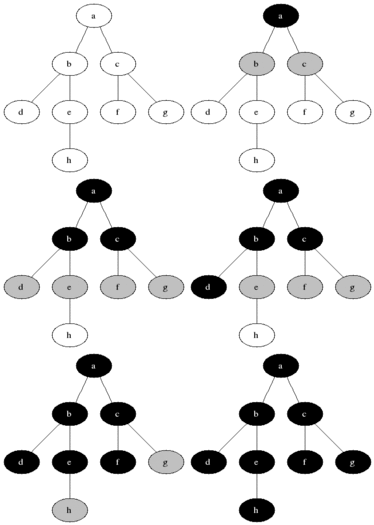
v->d // the distance of vertex from x
v->π  // a pointer to the vertex through which v was found the first time, NIL for undiscovered vertices (predecessor)
v->color // the color white, grey ,black
v->Adj //the set of the neighbours of v


BFS(s) // s is the source
// set all the vertices  color = WHITE, d = ∞ π = NIL

s->grey // set it as discovered
s->d := 0  // source distance is 0
PUSH(Q,s)	// pish the source into the queue

While !Q.empty() do{
	u:= pop(Q)		// take the next vertex from the queue
	for each v ∈  u→Adj  // go trhough each neightobur
		if v->color = WHITE then
			v-> color := GREY
			v->d: u->d + 1// incrmeent the distance
			v-> π := u  // vertex v was reached through u
			PUSH(Q,v)
	u->color := BLACK // make it processed
}
- before calling the algorithm the nodes need to be initialised and it takes $ O(V) $
- Scans the out Adj edges of the vertex,
- each queue operation is a constant time
- amount of WHILE loop takes $ O(V) $ because each vertex can be pushed into the queue once
- amount of FOR loop is exected at most $O(E)$ goes through each edge once into both direction
- The running time of BFS is $O(V+E)$
PRINT-PATH(G,s,v)
if v=s then  //base case
	print s
else if (v->π = NIL) then // the search didnt reach the vertex v at all
	print "no path"
else
	PRINT-PATH(G,s,v->π) //recursive call
	print v					//print afterwards
e.g PRINT-PATH(G,a,h) —> RETURN a,b,c,h
Depth-first Search

- only vertices that havent been seen before are accepted into the path
- once the algorihm cannot go further , it backtracks only as much as is needed in order to find a new route forwaeds
- the algotirhm stops once it backtracks back to the source and there are no unexplored edges left there
DIfference to BFS
- Instead of a queue the vertes waiting to be processed are put into a stack
- the algorithm doesnt find the shortest paths but path
v->d // the distance of vertex from x
v->π  // a pointer to the vertex through which v was found the first time, NIL for undiscovered vertices (predecessor)
v->color // the color white, grey ,black
v->Adj //the set of the neighbours of v

DFS(s)  // s is the source
// set all the vertices  color = WHITE, d = ∞ π = NIL
PUSH(S,s)
while !S.empty do
	u:= POP(S) 			// pop the latest vertex added to the stack
	if u->color = WHITE then // if it is unprocessed
		u->colour := GREY	//mark it discovered
		PUSH(S,u)			// Push it into the stack
		for each v ∈ u→Adj do
			if v->color = WHITE then
				push (S,v)
			else if v->color = GREY then // Grey node, CYCLE IS FOUND
				//cycle handling

	else
		u->color := BLACK 		//all neighbours handled
Efficiency
- Before calling the algorithm the nodes need to be initlaized so it takes $O(V)$
- stack operation is $\Theta(1)$
- The while loop makes atmost $O(V)$ rounds
- The algorithm goes through each edge once into both directions ,it takes $O(V+E)$
Recuisive DFS

DFS(u)
u->colour := GRAY
for each v ∈ u→Adj do
	if v->colour = WHITE then  // if v hasn't been visited
		DFS(v)						//contiue to search recursively from v
	else if v->colour = GRAY then	// if has been visited but not fully processed
		//	a loop is found
v-> colour := BLACK				//Mark node as fully processed
Running time
- a vertex is colored grey at the begining of the function
- DFS is called atmost $O(V)$
- There are atmost $O(E)$ rounds of the for loop
- other operations are constant time
- The running time is $O(V+E)$
BFS vs DFS
- BFS can be used for searching the shortest path
- if the stae space of the graph is larget, the BFS takes significantly larger amount of memory
- e.g arificial intelligence application
- DFS used for searching for loops
- the grey nodes form a path from the source to the current vetex
- only black or grey vertices can be accessed through a black vertex
- if a grey vertex can be reached from the current vertex, there is a loop in the graph
Dijkstra’s Algorithm
-
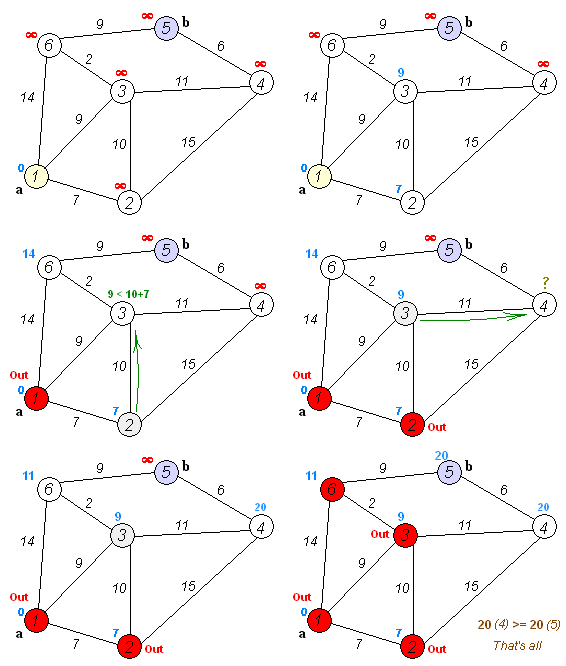
weight can be added to the edges of the graph
- can present the length of the route or the cost of the state transition
- The shortest route from the source to vertex
- is the one whose combined weight of the edges **as small as possible**
-
The weight of each edge is 1, the problem can be solved with scanning through the part of graph reachable from the source with BFS
-
if the weights can be < 0, it is possible that there is no solution to the problem
- although there are possible paths in the graph
- The algorithm is used for shortest weighted paths
- find the shortest paths from the source $s$ to all vertices reachale from $s$
- by weighting the lengths of the edges with $w$
- choose in each situation that the shortest path that hasn’t investigated yet
- Greedy algorithm
- find the shortest paths from the source $s$ to all vertices reachale from $s$
-
The algorithm uses a data Structure $Q$, which means $\text{Priority Queue} $
-
$w$ contains the weights of all edges
- $Relax$ algorithm
- relaxation of the edge($v,u$)
- tests could the shortest path found to vertex $v$ be improved
- by routing its end through $u$ and does so if necessary
v->d // the distance of vertex from x v->π // a pointer to the vertex through which v was found the first time, NIL for undiscovered vertices (predecessor) v->color // the color white, grey ,black v->Adj //the set of the neighbours of v Q is the Priority Queue DIJKSTRA(s,w) // s as the source // set all the vertices color = WHITE, d = ∞ π = NIL s->colour := GRAY //mark it discorvered s->d := 0 // the distance from the source to itself is 0 PUSH(Q,s) // coutinue while there are vetices left While !Q.empty //Where there are vetices left u:= EXTRACT-MIN(Q) take the next vertex from the priority queue for each v ∈ u→Adj do //go through the neighbours of u if v->colour:=WHITE then // if the node hasnt been visited v->colour := GRAY //mark it found PUSH(Q,v) //push the vertex into the queue RELAX(u,v,w) u->colour :=BLACK //mark u as processed RELAX(u,v,w) if(v->d > u->d + w(u,v) ) // if a new shorter route tov was found v-> d := u->d + w(u,v) //update the distance v→π := u //update the parent - relaxation of the edge($v,u$)
Running-Time
-
While loop takes $O(V)$ rounds and the for loop takes atmost $O(E)$ rounds
-
The priority queue can be implemented efficiently with a heap or less efficiently with a list
-
HEAP LIST empty data structure insertion $\Theta(1)$ $\Theta(1)$ check the priority queue empty $\Theta(1)$ $\Theta(1)$ Extract Min $O(logV)$ $O(V)$ Push the data into the queue $\Theta(1)$ $\Theta(1)$ Relaxation can change the priority of the vertex $O(logV)$ $\Theta(1)$
-
-
$O((V+E)logV)$
A* Algorithm
-
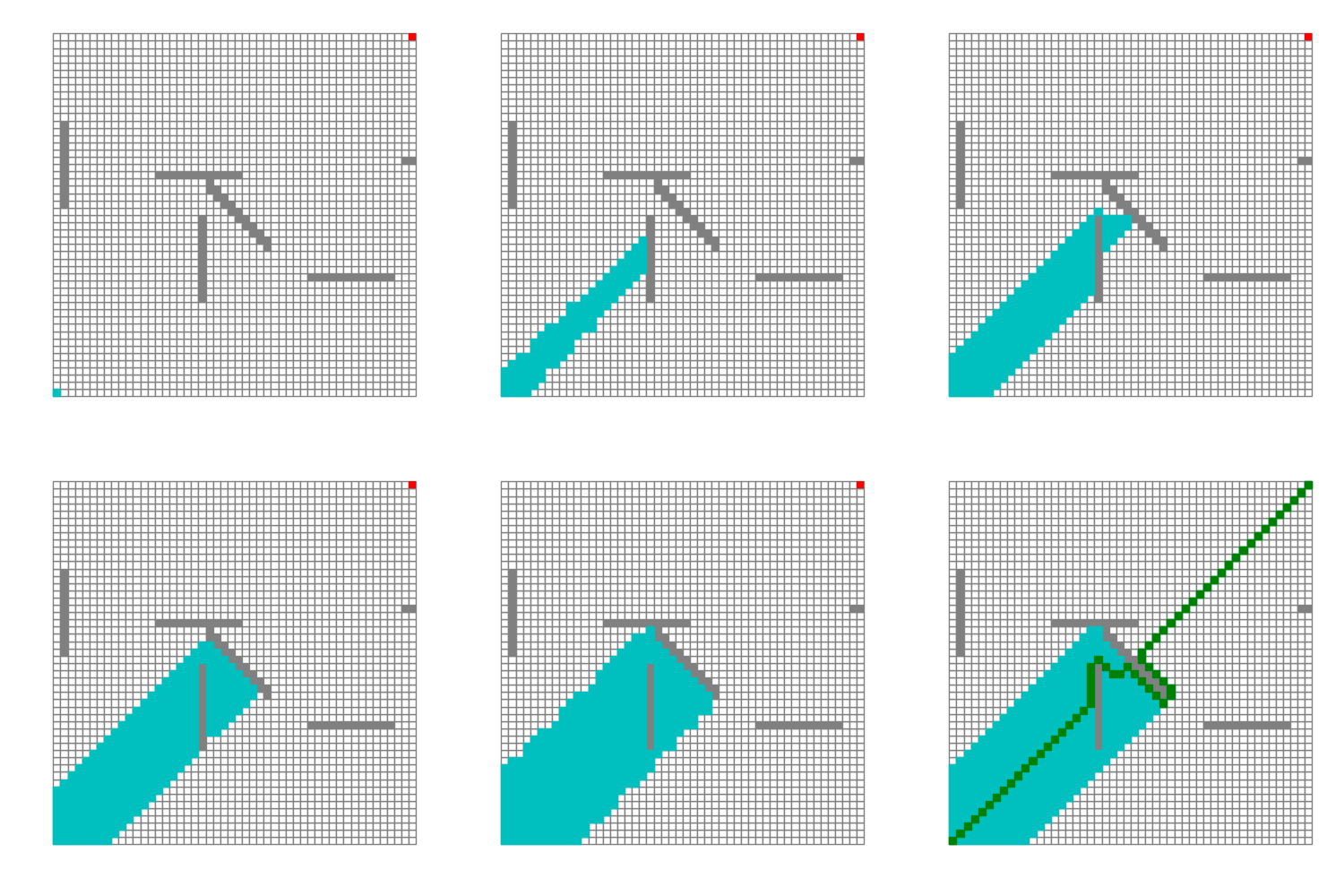
Dijkstra’s algorithm finds the shortest weighted route by accessing the nodes in the order of shortest route
- A algorithm* enhances this by adding a heuristic about the shortest possible distance to the goal (The direct distance in a road network)
- find the shortest weighted route from starting node $s$ to given goal node $g$.
- Does not find the shortest route to all nodes
- assumes that the minimum possible distance from any node to the goal can be calculated
- chooses in each situation a new node, whose is smallest.
- Just changes the Relaxation
RELAX-A* (u,v,w)
if v->d > u->d +w(u,v) then 	//if a shorter route to node v is found
	v-> d := u->d + w(u,v)		//new route this far
	v->de := v->d + min_est(v,goal) //minimum estimate for the whole route
	v→π := u