Chapter 3, Need finding
Workshop 3 - Need Finding
How to start
-
Understanding users/stakeholders and their context, such as needs, goals and values
- Who are the users?
- What do they think/say/feel?
- Why and how they do it?
- Where and when they do it?
- With what they do it?
Lead & Extreme users
Lead users
-
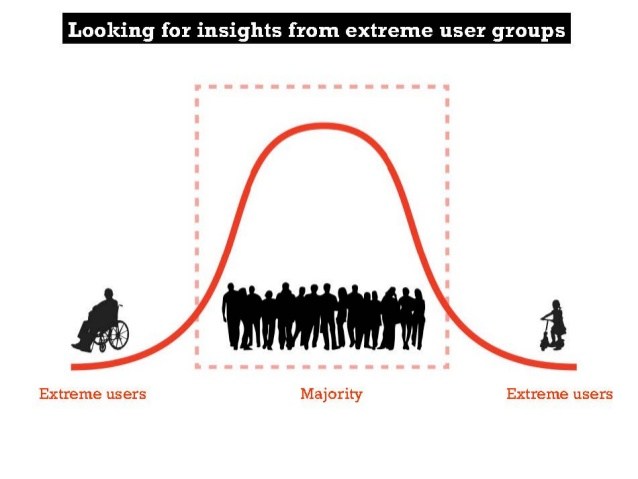
Lead users face needs that will be general in a marketplace months or years before the bulk of that marketplace encounter them
-
Lead users positioned to benefit significantly by obtaining a solution to their needs.
-
Lead users are users of a product or service that currently experience needs still unknown to the public and who also benefit greatly if they obtain a solution to these needs
-
領先用戶面臨在市場中具有普遍意義的需求 - 但會在市場大眾遇到這些需求的數月或數年前遇到這些需求
-
領先用戶位於有利位置上,可以通過得到這些需求的解決方案提供重要的幫助。
Extreme users
- From technophiles to technophobes or non-users
Stakeholders
Anyone who is affected by the success or failure of the system . Dix et al. 2004 p.458
Stakeholders Classification
| Stakeholders type | Description |
|---|---|
| Primary stakeholders (主要持份者) | use the system (internal stakeholders+ connected stakeholders) |
| Secondary stakeholders(次級持份者) | receive output or provide input(external stakeholders) |
| Tertiary stakeholders(三級持份者) | affected by the success or failure |
| Facilitating stakeholders(實施持份者) | developers, maintainance |
Stakeholder Analysis
Stakeholder Analysis is the first step in Stakeholder Management , an important process that successful people use to win support from others. Managing stakeholders helps them to ensure that their projects succeed where others might fail.
Steps for Stakeholder Analysis
Step 1: Identify your Stakeholder
Step 2: Prioritize your Stakeholder
Step3: Understand your key Stakeholder
Power/Interest Grid
- for stakeholder prioritisation
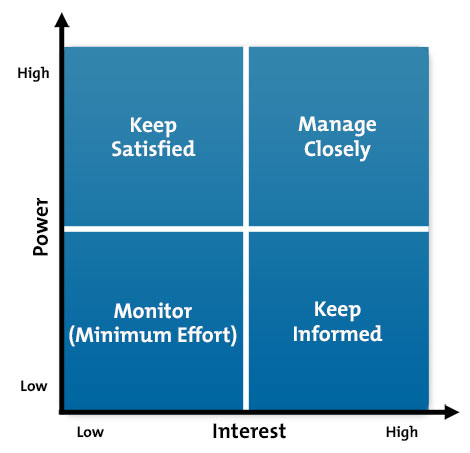
The Power/Interest Grid contains four quadrants. Each quadrant gives you an indication of the level of stakeholder management that you’ll have to employ and may also influence the type of communication style.
High power, highly interested people (Manage Closely): you must fully engage these people, and make the greatest efforts to satisfy them.
High power, less interested people (Keep Satisfied): put enough work in with these people to keep them satisfied, but not so much that they become bored with your message.
Low power, highly interested people (Keep Informed): adequately inform these people, and talk to them to ensure that no major issues are arising. People in this category can often be very helpful with the detail of your project.
Low power, less interested people (Monitor): again, monitor these people, but don’t bore them with excessive communication.
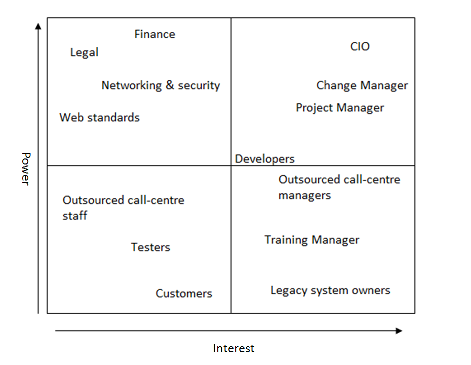
Example of Power/Interest Grid
Software Project
Needs
Why focus on needs?
- Needs last longer than any specific solution
- Needs are opportunities to exploit(發揮) rather than guesses at future
- Needs provides a roadmap for further development
- Needs stimulate actions
Ways to identify user needs
- Observations
- Interviews
- Diary Studies
- Also questionnaires (use with caution)
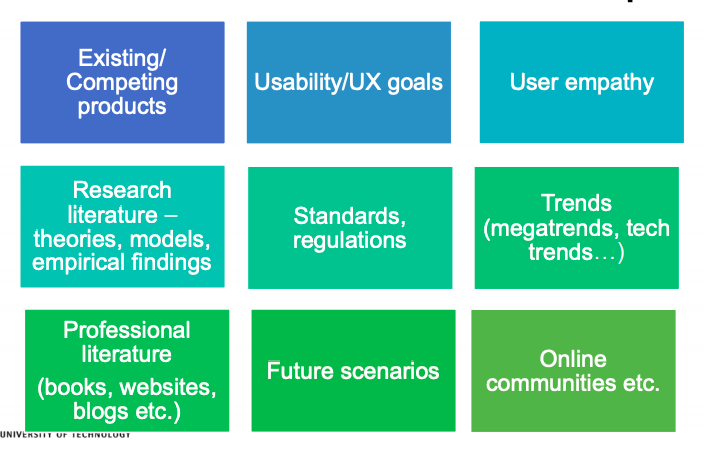
- Other sources of information
Other sources of information/inspiration
Observation
Viewing users and how they behave in context to learn about their experiences
- Uncovering latent needs
- Building empathy for the users and thinking from their point of view
- Learning from extreme or non-users
Obersvation Stated Questions
What is the context like?
What do people do (activites, interactions)?
What values and goals they have?
What are the higher level goals and activities?(purpose?)
What are the similarities and differences across people?
What hacks and workarounds are used?(變通方法)
What does not happen ?(有什麼沒有發生?)
Observation Approaches
Spending time with users & play your role
use public materials (public camera, online group)
Observation collect
Collect stories, quotes, and moods
Digital artefacts as photos, videos, drawing to show people’s feelings, challenges, problems, etc.
Audio video recording
Own sketches/scenarios/notes
Diary Studies
what is it?
Create a structured diary for users to fill in
The diary includes description of context
Usually focused on specifc things
- What are you doing at this moment
- Where are you and with whom
- How do you feel now
May be arranged in a form, confortable for users
Paper-based, electronic form, audio-based, photos with explanatory text
Experience Sampling(經驗取樣法)
設計師以取樣的方式,蒐集測試者當下的行為、想法及感受
Participants are prompted to answer questions in predefined schedules or at/after certain events
經驗取樣法的操作
- 紀錄受測者在實驗中,現場的觀察以及個人的感受
- 受測者在實驗前要能夠理解觀察目的,避免造成受測者的觀察結果偏差
- 透過定時,或是遠端提醒的裝置來告知受測者開始記錄
- 避免預期的心理,受測者在接到訊號後才開始進行狀態的記錄
- 提示裝置的類型沒有一定限制,只要能夠告知受測者開始記錄即可 (Ex: 呼叫器、鬧鐘、App…等)
- 觀察記錄需要事先定義好記錄的方式及格式 (Ex: 問題、文字敘述、素描、攝影、錄音…等)
Interview
The main purpose of the interview is to
-
uncover userful insights and
-
explore what users really needs/wants.
State the objectives accurately
- What do you want to learn?
- Where should you focus?
- How to reveal latent needs?
- How will you use/analyze recevied data?
Plan the interview
- Generate a list of questions and design and design your inteview script to guide you
Remember about ethics
- Be polite, try to keep friendly and comfortable atmosphere, focus on interviewee, not on reporting
Intercept Interview
Intercept Interviews are designed to increase understanding and dialogue through a series of quick questions that take no more than 10 to 15 minutes of dialogue.
Segmentation
Definition
to divide the marketplace into parts, or segments, which are definable, accessible, actionable, and profitable and have a growth potential.
In other words, a company would find it impossible to target the entire market, because of time, cost and effort restrictions.
It needs to have a ‘definable’ segment - a mass of people who can be identified and targeted with reasonable effort, cost and time.

Why Segmentation?
User and consumers are different
- Different basis for grouping them
- Backgrounds, motivation, needs, wealth, lifestyle
- Education, experience, culture, technology attitudes etc.
Different people have different needs(latent & explicit)
Right product—>Right segment
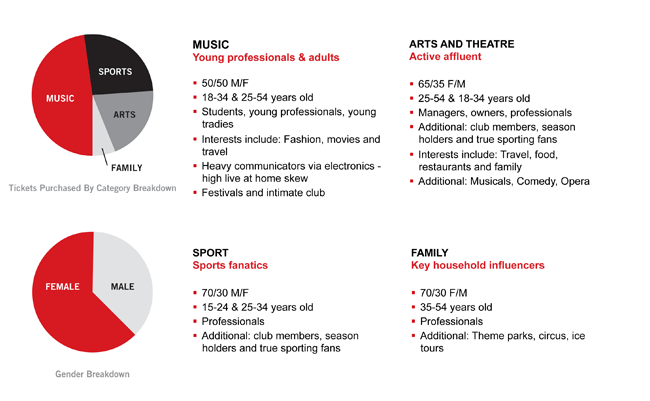
Segmentation Profile
A segment profile is a detailed description of the market segment across a range of factors and measures. It is designed to provide the organization with a good understanding of consumers within each segment for comparison and strategy purposes.