Chapter 5, Experiment_and_Validate
HCPD_05_Experiment_and_Validate
Concept
an abstract or generic idea generalized from particular instances
e.g. the concept of psychology, the concept of gravity
Concept for a HCPD product
- How it works? (Principle)
- How is the solution differ from the product of today (Differences)
- What are the customer segments for your proudct(Target Customers)
Values
| Values | Description |
|---|---|
| Functional value(功能性價值) | What can the product do? How can the proudct solve particular problems |
| Financial Value | Reasonable Price? Profitible? |
| Social Value | Enable users to connect with others |
| Psychological Value | Enable the feeling of users. Make them happy, pleasure, or scared. Stimulate their emotions. |
Value Proposition Canvas
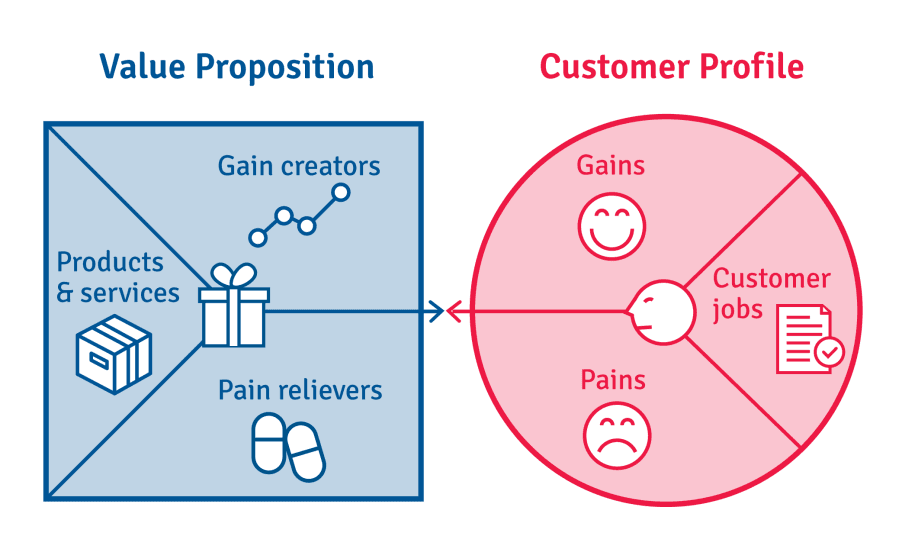
The Value Proposition Canvas is a tool which can help ensure that a product or service is positioned around what the customer values and needs.
| Customer Profile | Description |
|---|---|
| Gains | The benefits which the customer expects and needs, what would delight customerss and the things which may increase likelihoood of adopting value position |
| Pains | The negative experiences, emotions and risks that the customer experiences in the process of getting the job done. |
| Customer Jobs | the functional, social, emotional tasks cstomers are trying to perform, problems they are trying to solve and needs they wish t satisfy |
| Value Map | Description |
|---|---|
| Gain Creators | How the prodcut or service creates customer gains and how it offers added value to the customer |
| Pain relievers | a description of exactly how the product or service alleviates customer pains |
| Prouducts and services | the products and services which create gain and relieve pain, and which underpin the creation of value for the customer |

MVP(Minimum Viable Product)
The minimum viable product is a strategy used for fast and quantitative market testing of a product or product feature.
Story Mapping
-
Capture the primary goal of the product
- understand what our product does
- what kind of problems it solves
- satisfy the customer

-
Define the main process in the product
- to think less about particular features and to think more about tasks such as: “Customise a shoe”, “Buy a shoe”, “Manage my orders”, “Get shoes delivered to my home”.*

-
Create a list of features for each stage
- try to boost our own creativity and define as many features as we can but at the same time avoid prioritization

-
Prioritize the features inside lists
Criteria :important, often, no.users, value, risky

-
Define the MVP
- The first row on the map defines something which Alistair Cockburn refers to as the Walking Skeleton
- Sometimes the Walking Skeleton is precisely an MVP, but very often this is not the case.
- Features which are essential are placed above the line and other features are placed below the line

User Goals
| Goals | Description |
|---|---|
| Experience Goals | how user wants to feel while using a product |
| End Goals | what user wants or needs to accomplish(main problem to solve) |
| Life Goals | describe a persona’s long-term desires ,motivations,self-image attributes |
Hypothesis statement
A proposed answer to a question or problem that can be verified or rejected through testing
- Define functions of the product for your MVP
- Create hypothesis statement and think how to evalute them
e.g. We believe that [doing this/having this feature/creating this expereince] for [target segment/context of use] will achieve [this outcome]
We will know this is true when we see [this market feedback, quantitative measure, qualittative insight]
User Testing vs Usability Testing
User Testing
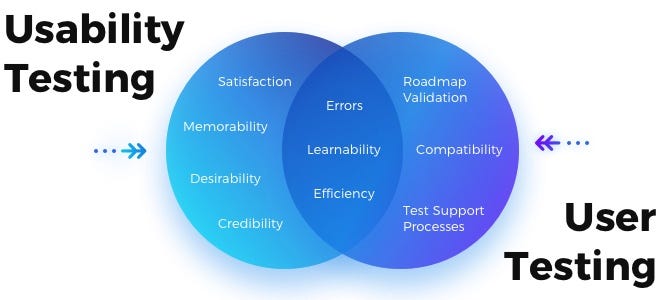
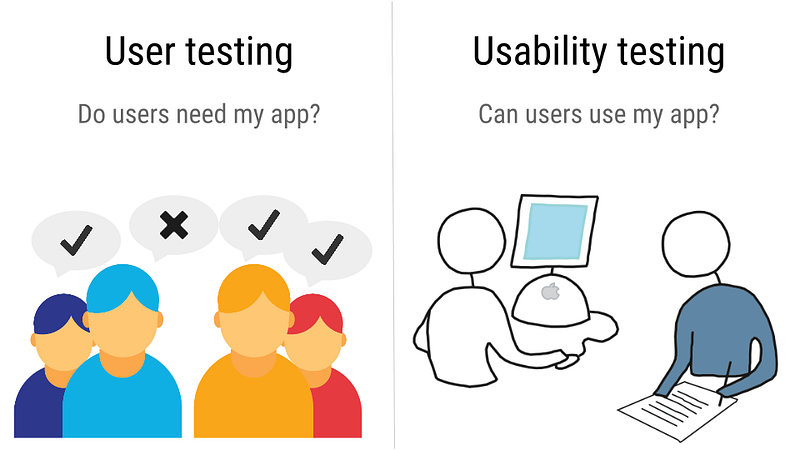
User Testing is more like testing the utility of your idea or app. It involves understanding how people do this thing as of today and will (and how) they use an alternative to do that same job
Usability Testing
The effectiveness, efficiency and satisfaction with which specified users achieve specified goals in particular environments.
Fidelity of Prototype
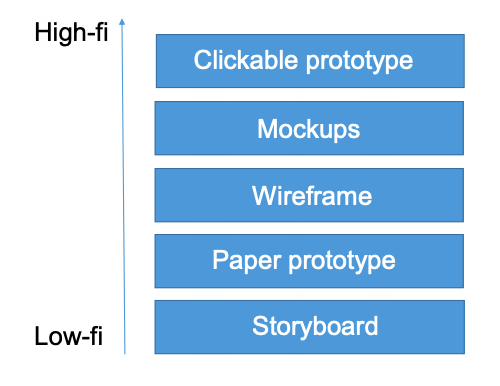
StoryBoard
- tools that visually predicts and explores a user’s experience with a proudct
- linear sequence of illustrations, arrayed together to visualize a story
-
help UX designers understand the flow of people’s interaction with a product over time, giving a clear sense of what’s really important for users
- help communicate and create a shared understanding of an idea
- Invites to explore the key aspects of the idea
-
Help to understand user’s points of view
- Focus on Clarity, Authenticity(本真) , simplicity, Emotion