ISO 9241-210:2010
Ergonomics of human–system interaction Part 210: Human-centred design for interactive systems (ISO 9241-210:2010) PDF_LINK
1. Scope
- Provides requirements and recommendations for human-centred design principles and activities throughout the life cycle of computer-based interactive system.
-
This part of ISO 9241 provides an overview of human-centred design activities.
- The information in this part of ISO 9241 is intended for use by those responsible for planning and managing projects that design and develop interactive systems
2. Terms and Definition
| Terms | Definition |
|---|---|
| Accessibility(無障礙,可接近) | usability of product, service, environment or facility by people with the widest range of capabilities |
| Context of Use(使用環境) | users, task, equipment, and the physical and social environment in which a proudct is used |
| Effectiveness | accuracy and completeness with which users achieve specified goals |
| Efficiency | resources expended in relation to the accurac and completeness with which users achieve goals |
| Ergonomics | scientific discipline concerned with the understanding of interactions among human and other elements of a system, and the profession that applies theory, principles, data and methods to design in order to optimize human well-being and overall system performance |
| Goals | intended outcome |
| Human-centred design | approach to systems design and development that aims to make interactive systems more usable by focusing on the use of the system and applying human factors/ergonomics and usbility knowledge and techniques |
| Interactive system | combination of hardware, software and services that receives input form, and commnciates output to users |
| Prototype | representation of all or part of an interactive system, that , although limited in some way, can be used for analysis, design and evaluation |
| Satisfaction | freedom from discomfort and positive attitudes towards the use of the proudct |
| Stakeholder | individual or organization having a right , share, claim or interest in a system or in its possession of characteristics that meet their needs and expectations |
| Task | activities required to achieve a goal |
| Usability(易用性) | extent to which a system, proudct or service can be used by specified users to achieve specified goals with effectiveness, efficiency and satifaction in a specified context of use |
| User | person who interacts with the product |
| User expereince | person’s perceptions and responses resulting from the use and/or anticipated use of a product, system or service |
| User Interface | all components of an interactive system that provide information and controls for the users to accomplish specific tasks with the interactive system |
| Validation | confirmation, through the provision of objective evidence, that the requirements for a specific intended use or application have been fulfilled. |
| verification | confirmation, through the provision of objective evidence, that specified requirements have been fulfilled |
Verification:確認達成規格 (requirements);
Validation:確認達成目的 (intended use).
3. Rationale for adopting human-centred Design
-
Has substantial economic and social benefits for users, employers and supplier
- Taking a human-centred design approach also increases the likelihood of completing the project successfully, on time,
- reduce the risk of the product failing to meet stakeholder requirements or being rejected by its users.
Systems designed using human-centred methods improve quality
- Increase the productivity of users and the operational effciency of organizations
- Being easier to understand and use, thus reducing training and support cost
- Increasing usability for people with a wider range of capabilities and thus increasing accessbility.
- Improving user experience
- Reducing discomfort and stress
- Providing a competitive advantage, for example by improving brand image
- Contributing towards sustainability objective.
4. Principle of human-centred design
4.1 General
-
a framework for human-centred design.
-
All the human-centred design activities identified in Clause 6 are applicable (to a greater or lesser extent) at any stage in the development of a system.
-
Human-Centred Approach Principles The design is based upon an explicit understanding of users, tasks and environments Users are involved throughout design and development The design is driven and refined by user-centred evaluation The process is iterative The design addresses the whole user experience The design team includes multidisciplinary skills and perspectives
4.2 The design is based upon an explicit understanding of users, tasks and environments
Products, systems and services should be designed to take account of the people who will use them as well as other stakeholder groups, including those who might be affected (directly or indirectly) by their use
4.3 Users are involved throughout design and development
The people who are involved should have capabilities, characteristics and experience that reflect the range of users for whom the system is being designed.
4.4 The design is driven and refined by user-centred evaluation
Evaluating designs with users and improving them based on their feedback provides an effective means of minimizing the risk of a system not meeting user or organizational needs (including those requirements that are hidden or difficult to specify explicitly)
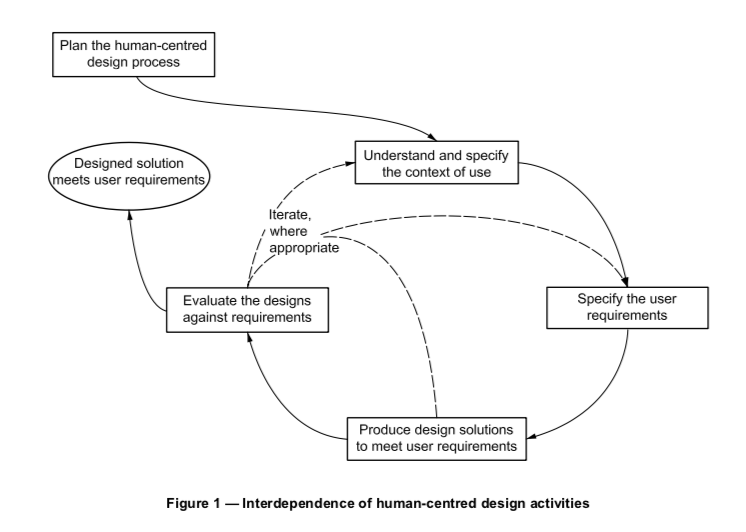
4.5 The process is iterative
Iteration should be used to progressively eliminate uncertainty during the development of interactive systems. Iteration implies that descriptions, specifications and prototypes are revised and refined when new information is obtained in order to minimize the risk of the system under development failing to meet user requirements.
4.6 The design addresses the whole user experience
User experience is a consequence of the presentation, functionality, system performance, interactive behaviour, and assistive capabilities of an interactive system, both hardware and software. It is also a consequence of the user’s prior experiences, attitudes, skills, habits and personality.
4.7 The design team includes multidisciplinary skills and perspectives
Human-centred design teams do not have to be large, but the team should be sufficiently diverse to collaborate over design and implementation trade-off decisions at appropriate times.
human factors and ergonomics, usability, accessibility, human-computer interaction, user research, users and other stakeholder groups, marketing, branding, sales, technical support and maintenance, health and safety, user interface, visual and product design,technical writing, training, user support, user management, service management and corporate governance, human resources, sustainability
5. Planning human-centred design
5.1 General
Human-centred design shall be planned and integrated into all phases of the product life cycle, i.e. conception, analysis, design, implementation, testing and maintenance.
5.2 Responsibility
Those responsible for planning the project shall consider the relative importance of human factors/ergonomics in the project by evaluating:
(需要考慮human factors/ergonomics在該project的重要性by評估以下項目)
a) How usability relates to the purpose and use of product, system or service(size,no. of users, realtionship with other systems, safety or health issues, accessibility, specialist application, extreme environments
b) The levels of various types of risk that might result from poor usability
(usability差的時候引致的風險)
c) The nature of the development environment(e.g. size of project, time to market,range of technologies, internal or external project, type of contract )
5.3 Content of plan
The planning of human-centred design shall include:
- identifying appropriate methods and resources for the activities for Clauses 6 (4.2-4.7)
- defining procedues and integrating these activities and their outputs with other system development activities
- identifying the individuals and the organization responsible for the human-centred design activities and the range of skills and viewpoints they provided
- developing effective procedures for establishing feedback and communciation on human-centred design activities as they affect other design activities and “trade-off”s, and methods for documenting outputs from these activities
- agreeing on appropriate milestones for human-centred activities that are integrated into the overall design and development process
- agreeing on suitable timescales to allow iteration, use of feedback and possible design changes to be incorporated into the project schedule.
5.4 Integration with project plan
the plan for human-centred design should be subject to the same project disciplines (e.g. responsibilities, change control) as other key activities.
The human-centred design aspects of the project plan should be reviewed and revised appropriately as requirements change throughout the life of the project.
6 Human-centred design activities
6.1 General
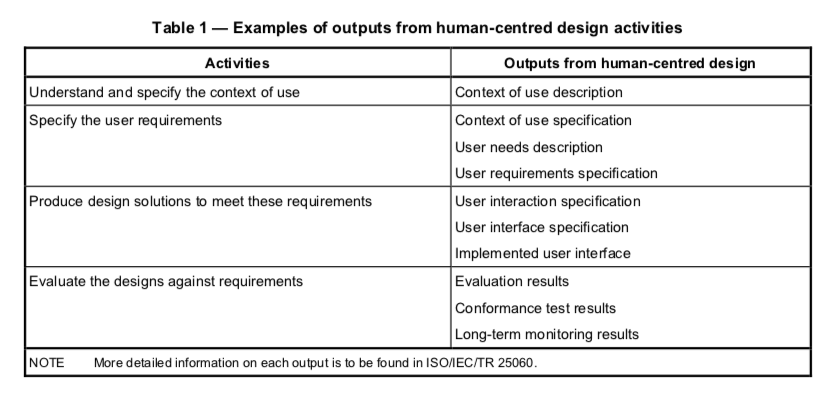
four linked human-centred design activities shall take place during the design of any interactive system:
- understanding and specifying the context of use (see 6.2); (
- specifying the user requirements (see 6.3);
- producing design solutions (see 6.4);
- evaluating the design (see 6.5).
6.2 Understanding and specifying the context of use
6.2.1 General
The characteristics of the users, tasks and organizational, technical and physical environment define the context in which the system is used. It is useful to gather and analyse information on the current context in order to understand, and then specify, the context that will apply to the future system
6.2.2 Context-of-use description
The context-of-use description shall include the following:
- The users and other stakeholder groups
- The characteristics of the users or groups of users
- The goals and tasks of the users
- The environment(s) of the system
6.2.3 Sufficient detail to support design
The context of use of the system should be described in sufficient detail to support the requirements, design and evaluation activities.
6.2.4 Context of use specified for design
The context of use specified for design (i.e. the context in which the system will be used) should be stated in the user requirements specification to clearly identify the conditions under which the requirements apply.
6.3 Specifying the user requirements
6.3.1 General
In most design projects, identifying user needs and specifying the functional and other requirements for the product or system is a major activity. For human-centred design, this activity shall be extended to create an explicit statement of user requirements in relation to the intended context of use and the business objectives of the system.
6.3.2 Identifying user and other stakeholder needs
User and other stakeholder needs should be identified, taking account of the context of use. These should include that which users need to achieve (rather than how to achieve it) and any constraints imposed by the context of use.
6.3.3 Deriving user requirements
| User Requirements Should Include |
|---|
| the intended context of use |
| requirements derived from user needs and the context of use — for example, there might be a requirement for a product to be used outdoors; |
| requirements arising from relevant ergonomics and user interface knowledge, standards and guidelines (ISO XXXX) |
| usability requirements and objectives, including measurable usability performance and satisfaction criteria in specific contexts of use |
| requirements derived from organizational requirements that directly affect the use |
6.3.4 Resolving trade-offs between user requirement
Potential conflicts between user requirements, e.g. between accuracy and speed, should be resolved.
6.3.5 Ensuring the quality of user requirements specifications
The user requirements specification should be
- stated in terms that permit subsequent testing,
- verified by the relevant stakeholders,
- internally consistent, and
- updated as necessary during the life of the project
6.4 Producing design solutions
6.4.1 General
Design decisions have a major impact on the user experience. Human-centred design aims to achieve a good user experience by considering it throughout the design process
-
designing user tasks, user-system interaction and user interface to meet user requirements, taking into consideration the whole user experience;
- making the design solutions more concrete (for example making use of scenarios, simulations, prototypes or mock-ups);
-
altering the design solutions in response to user-centred evaluation and feedback (see 6.5 for details on user evaluation);
- communicating the design solutions to those responsible for their implementation
6.4.2. Designing user tasks, user–system interaction and user interface to meet user requirements, taking into consideration the whole user experience
6.4.2.1 Principles for design
- Suitability for the task( the fact of being acceptable or right for something or someone)
- Self-descriptiveness (to describe itself with no external help)
- Confomity with user expectations(一致性)
- Suitability for learning (it is necessary to learn how to use certain functions of a product, this should be as easy as possible)
- Controllability(可控性)
- error tolerance
- suitability for individualization (users can adapt the product to their own needs)
6.4.2.2 Designing the tasks and interaction between user and system
Appropriate design of the user–system interaction relies on a clear understanding of the intended context of use, including the users’ roles and tasks and their outputs. This understanding enables an appropriate allocation of functions to be achieved, i.e. the division of system tasks into those performed by humans and those performed by technology.
Designing the interaction should include
- Making high-level decisions(initial design concept)
- Identifying tasks and sub-tasks
- Allocating tasks and sub-tasks to the users and to other parts of the system
- Identifying the interaction objects required for the completion of the tasks
- Identifying and selecting appropriate dialogue techniques
- Designing the dequence and timing of the interaction
- Designing the information architecture of the user interface of an interactive system to allow efficient access to interaction objects.
6.4.2.3 Designing the user interface
For the detailed design of the user interface, there is a substantial body of ergonomics and user interface knowledge, standards and guidelines which should be used to inform the design of both hardware and software.
These include standards within the ISO 9241 series on displays, input devices, dialogue principles, menus, presentation of information, user guidance, and other user interface and accessibility guidelines.
6.4.3 Making design solutions more concrete
Using scenarios, simulations, models and mock-ups or other forms of prototype enables designers to communicate the proposed design to users and other stakeholders to obtain feedback.
Benefits
- Making design more explicit
- Allow designers to explore serveral design concepts before they settle on one
- Making it possible to incorporate user feedback into the design early in the devleopment process
- Making it possible to evaluate several iterations of a design and alternative designs
- improving the quality and completeness of the functional design specification.
6.4.4 Altering the design solutions based on user-centred evaluation and feedback
Feedback from evaluation should be used to improve and refine the system
6.4.5 Communicating the design solution to those responsible for implementation
Whatever the nature of the overall project, there should be some sustained channel of communication between those responsible for human-centred design and other members of the project team. When design solutions are communicated, they should be accompanied by an explanation and justification of the design decisions, especially where trade-offs are necessary.
6.5 Evaluating the design
6.5.1 General
User-centred evaluation (evaluation based on users’ perspective) is a required activity in human-centred design.
User-centred evaluation can be used to
- collect new information about user needs
- provide feedback on strengths and weaknesses of the design solution from the user’s perspective (in order to improve design )
- asses whether user requirements have been achieved which can include assessing conformity to international, national, local, corporate or statutory standards.
- establish baselines or make comparisons between designs
6.5.2 Conducting user-centred evaluation
- allocating resources both to obtain early feedback in order to improve the proudct , and at a later stage, to determine whether the requiremnts have been satisfied
- planning the user-centred evaluation so that it fits the project schedule
- carrying out sufficiently comprehensive testing to provide meaningful results for the system as a whole
- analysing the results, prioritizing issues and proposing solutions;
- communicating the solutions appropriately so that they can be used effectively by the design team
6.5.3 User-centred evaluation methods
ISO/TR 16982.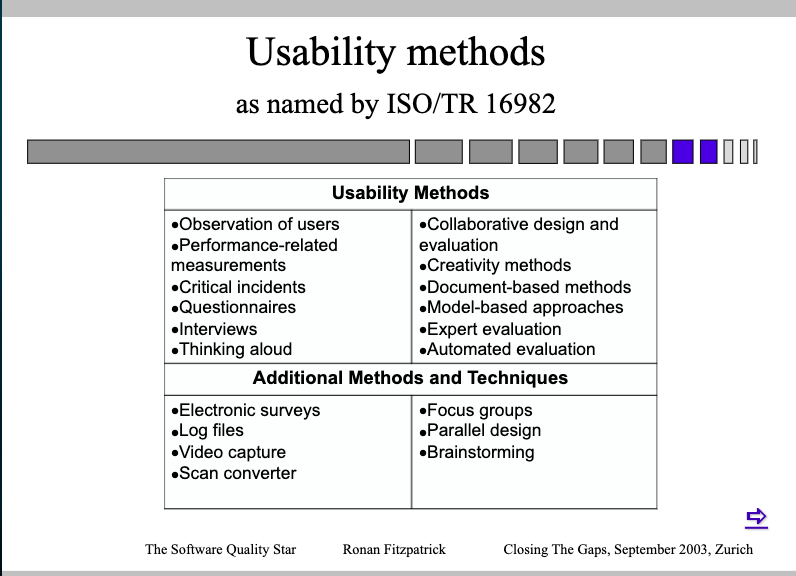
6.5.4 User-based testing
User-based testing can be undertaken at any stage in the design.
At a very early stage, users can be presented with models, scenarios or sketches of the design concepts and asked to evaluate them in relation to a real context.
When prototypes are being tested, the users should carry out tasks using the prototype rather than just be shown demonstrations or a preview of the design. The information gathered is used to drive the design.
At a later stage in the development, user-based testing can be carried out to assess whether usability objectives, including measurable usability performance and satisfaction criteria, have been met in the intended context or contexts of use.
Techniques that can be used to gather data from field validation include help-desk data, field reports, incident analysis, near-miss reports, log files, defect reports, real user feedback, performance data, satisfaction surveys, reports of health impacts, design improvements, user observation and requests for changes.
6.5.5 Inspection-based evaluation
Inspection-based evaluation can be valuable and cost-effective and can also complement user testing. It can be used to eliminate major issues before user testing and hence make user testing more cost-effective.
Inspection-based evaluation is ideally performed by usability experts who base their judgement on prior experience of problems encountered by users and their own knowledge of ergonomic guidelines and standards.
Inspection-based evaluation can be supported by checklists, lists of user requirements, general usability guidance, industry best practices, usability heuristics, guidelines or standards.
The effectiveness of the inspection always depends on the skills, experience and knowledge of the evaluators
6.5.6 Long-term monitoring
A human-centred design process should also include long-term monitoring of the use of the product, system or service. This involves collecting user input in different ways over a period of time.
Follow-up evaluation is often a formal part of system evaluation and is carried out within a specific time frame, e.g. six months to a year after the system is installed.
Some effects of working with an interactive product, system or service are not recognizable until it has been used for a period of time.
7 Sustainability and human-centred design
Human-centred design directly supports the first two pillars of sustainability:
-
Sustainability Description Economic matching a design to users’ needs and abilities enhances its utilization, quality and efficiency, thus providing cost-effective solutions and reducing the likelihood that systems products and services will be wasteful or rejected by their users; social taking a human-centred approach results in systems, products and services that are better for the health, well-being and engagement of their users, including users with disabilities.