Chapter 5 - Asynchronous Communication
Asynchronous communication, Web Sockets, MQTT
Synchronous communication
Example of synchronous communication
- A user clicks a button on a webpage
- The browser makes a HTTP request to the server
- The browser waits until the server repsonds and renders and renders the output on the reponse
JavaScript brings asynchronous nature to the UI. exmaple
- A user clicks a button on a web page. This is intercepted by the JS layer.
- The JS layer makes a HTTP request to the server and binds an event handler to execute when the response arrives. Other activities can continue meanwhile.
- When the server responds, the event handler code is executed

Asynchronous Communication
- Asycnronous commuicnation is often neccessary on the web
- HTTP requests have a time limit
- Activities may actually take long(e.g hours)
- We do not have control of the other end or its load
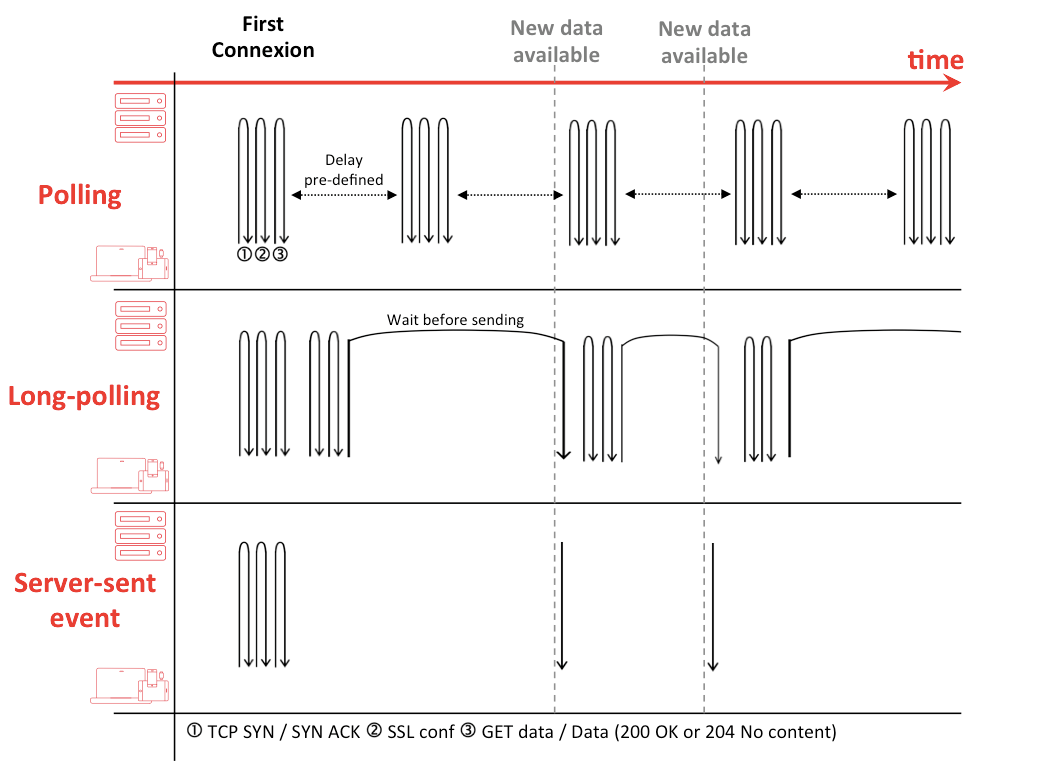
- Three common ways to implement asynchronous communication using HTTP
- Polling
- Sending requets at a consistent rate and server returns updates accordingly
- Long-polling
- the client sends a request which is immediately responded ,followed by another request for which the server returns a response when something new is available
- Push
- after a request is being sent, the repsonse by the server kept open.
- Polling
Web Socket
- HTTP is not a bi-directonal protocol
- Web Sockets provdes full-duplex communication channel over a single TCP connection
- Allows interaction between a web browser or any other client application and the web server with lower overhead
- No need to make requests, each party can send content and pass messages back and forth
- Designed for standard ports 80 and 443 to be usable with firewall
Client request:
GET / HTTP/1.1
Upgrade: websocket
Connection: Upgrade
Host: example.com
Origin: http://example.com
Sec-WebSocket-Key: sN9cRrP/n9NdMgdcy2VJFQ==
Sec-WebSocket-Version: 13
Server Respose:
HTTP/1.1 101 Switching Protocols
Upgrade: websocket
Connection: Upgrade
Sec-WebSocket-Accept: fFBooB7FAkLlXgRSz0BT3v4hq5s=
Sec-WebSocket-Location: ws://example.com/
Message Brokers

- can act as an intermediary between two communicating parties
- Asynchronous by nature
- Pattern
- Streams/queues
- Publish-subscribe
- Many support HTTP, REST,SOAP or any other means for client/application components to connect
MQTT(OASIS)
-
Message Queuing Telemetry Transport
-
Lightweight IoT or M2M protocol
-
Based on publish/subscibe communication pattern
- event-driven and enbales messages to be pushed to clients
-
Message exchanged based on topics
- my house/bedroom2/temperature
- house/+/temperature
- house/#
-
JSON/XML or whatever content

MQTT messages and QoS
-
Messages
- Connect
- Disconnet
- Publich(TopicName, QoS, RetainFlag, Payload, Packet identifier, …)
- Subscribe/SubAck
- Unsubscrible /UnsubAck
-
Each connection has QoS measure
-
at most once (QoS 0)
- the message is sent once and the client and broker take no additional steps to acknowledge delivery (fire and forget)
-
-
At least once (QoS1)
- the sender re-sends the message multiple times until acknowledgement is received (acknowledged delivery)
- Exactly once (QoS2)
- the sender and receiver engage in a handshake to ensure only one copy of the message is received (Assured Delivery)
AMQP
-
Adanced Message Queuing Protocol is an open standard protocol for message oriented middleware
-
- Message Oriented Middleware is a concept that involves the passing of data between applications using a communication channel that carries self-contained units of information (messages).
- AMQP was designed to efficiently support a wide variety of messaging applications and communication patterns.
-
Typically AMQP is used as a message broker and it has much more complex and versatile communication patterns than, for example, MQTT
- Two versions currently
- Pre 1.0 (e.g. 0-9-1 RabbitMQ, …)
- 1.0 (ISO/IEC 19464) (fewer implementations, more complex)
- Can be scaled and chained using multiple message broker instances for extreme scalability (fairly easy above 1M+ message per second)
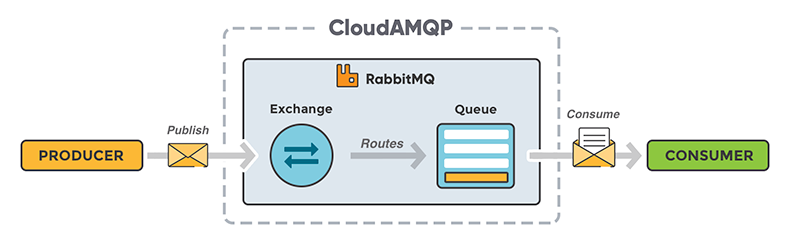
Exchange
- Exchanges are AMQP 0-9-1 entities where messages are sent
- Exchanges take a message and route it into zero or more queues.
- The routing algorithm used depends on the exchange type and rules called bindings
| Name | Default pre-declared names |
|---|---|
| Direct exchange | (Empty string) and amq.direct |
| Fanout exchange | amq.fanout |
| Topic exchange | amq.topic |
| Headers exchange | amq.match (and amq.headers in RabbitMQ) |
| Illustration of the | |
|---|---|
 |
It has one special property that makes it very useful for simple applications: every queue that is created is automatically bound to it with a routing key which is the same as the queue name. |
 |
A fanout exchange routes messages to all of the queues that are bound to it and the routing key is ignored. Fanout exchanges are ideal for the broadcast routing of messages. |
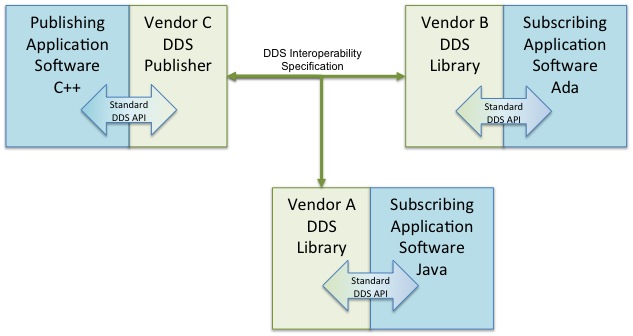
DDS - Data Distribution Service
- A real-time machine to machine communication standard aiming to enable data exchange in a publish-subscribe pattern to be
- scalable
- real-time
- dependable
- high-performance
- interoperable
- Intended application areas includes
- Air-traffic control
- Smart-grid management
- Autonomous vehicles
- Robotics
- Transportation systems
- Aerospace
- Characteristics
- Empahasis on QoS parameters and configuration up-front
- Anonymous transmission of messages
- Automatic failover and handling of-redundant information sources
OPC UA

-
Communication Standard originally designed for industrial automation and control purposes but nowadays has application in many other application areas as well
-
Designed to unify communication and facilitate integration of components from different vendors
OPC UA Publish/Subscribe (2018)
- Message Bus based publish/subscribe communication
- Enables using the OPC UA information model in other means of communication and standard exchange such as MQTT and AMQP