Chapter 7 - Serverless Implementation consideration
Serverless, implementation considerations
Traditional Web Application Vs. Serverless

What is Considered in Serverless
- FaaS
- Function as a Service
- chunks of code are executed and the short-lived run time instances are formed in response to events like HTTP calls to an API gateway or messages on a message bus or queue
-
BaaS
- Back-end as a Service
- Servies that provide functionality such as storage, messaging or authentication that typically scale well. e.g. Azure Cosmos, AWS dynamo DB

-
Fass Bass Common
- Server configuration and capacity management are completely hidden from developers and operators.
- Costs are aligned with the use of resources
Serverless Architecture

Chanllenges
- Performance and latency
- Resource limits vs dedicated instances
- Secruity of infrastructure and service functions
- Privacy of data and operations
- Monitoring and debugging is not as straightforward
Software architecture and development challenges
- Service and function dependencies, orchestration
- Sercurity, authentication and authorisatinon of distributed invocations
- Logging and keeping track of service and function performance
- Debugging and analysing
- Managing functions and services throughout the lifecycle
- Communication between teams
Serverless software architecture
Cloud Application Matrurity

| Level | Matrurity | Criteria |
|---|---|---|
| 3 | Cloud Native | - Transferable across infrastructure providers at runtime and without interruption of service - Automatically scale out/in based on stimuli |
| 2 | Cloud resilient | -State is isolated in a minimum of services -Unaffected by dependent service failure -Infrastructure Agnostic |
| 1 | Cloud Friendly | -Composed of loosely couled services -Services are discoverable by name -Components are designed to cloud patterns -Compute and storage are separated |
| 0 | Cloud ready | -Operated on virtualized infrastructure -Instantiateble from image or script |
Cloud-Native Stack

Always On vs On Demand
- Always-on components are one of the most expensive and avoidable cloud workloads
- Even with microservices architecture, there needs to be at least one microservice instance that is always on
- one containers instance running for each different micro service type
- The function as a service approach exectue services only when requests take place (trigger activate)
Blueprint of a serverless platform architecture
![Blueprint of a serverless platform architecture (adapted from [41])Â](https://www.researchgate.net/profile/Nane_Kratzke/publication/326423781/figure/fig3/AS:649038529576961@1531754252246/Blueprint-of-a-serverless-platform-architecture-adapted-from-41.png)
Cloud Application Architecture Redesign

Serverless promotes event-driven

Hybrid approach to serverless

Patterns for the Serverless Architecture
Comman Pattern
- Invoke and control functions and services from a single function
- Simplify, customise or extend API gateway functionality
- If a response is required tp the API GW , another function adds latency

The command pattern is used to invoke and control functions and services from a single function.
Messaging pattern
-
allows developers to build scalable and robust systems by decoupling functions and services from direct dependence on one another
-
allowing storage of events/records/requests in a queue.

The messaging pattern, and its many variations, are popular in distributed environments
Priority Queue Pattern
- Different priority on processing of messages
- The system can implement workflows and use different services and APIs to cater for many types of needs and users

The priority queue pattern is an evolution of the messaging pattern.
Fan-out Pattern
-
Push messages to all listenrs or necessary functions or services using a queue or a message pipeline
-
Practical when multiple functions are needed to be invoked or as a in between if the function only supports one
####

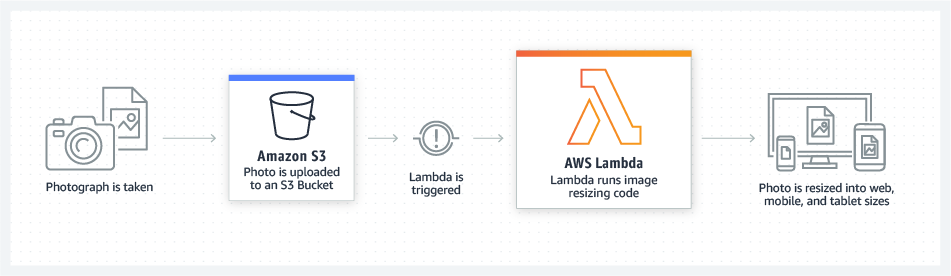
The fan-out pattern is useful, as many AWS services (such as S3) can’t invoke more than one Lambda function when an event takes place.
Orchestration of functions
AWS Steps Functions

Implementation considerations and concerns
Security Considerations
- Everything is managed by your provider
- Infrastructure, OS, VM, containerization, library support
- All functions are entry points
- Dependency on external services
- Privacy
- Exectuion patterns, number of requests. etc.
Code-Related Concern
- Vulnerable libraries fetched from Maven and npm repositories and the likes. Functions are stale and static libraries are not auto-updated
- There might be nothing that notifies you even of their existence
- Easy to copy & paste the codes, scripts, or even docket containers that are not or cannot be thoroughly reviewed
- Permissions - its easier to add too many (and hard ot remove later on without breaking stuff)
Features of Serveless
- Instance have a lifetime
- when request frequency increases , the instance lifetime tends to become shorter
- easier to balance resources for consistent loads

- when request frequency increases , the instance lifetime tends to become shorter
- ColdStarts
- launching a new function instance
- Allocating memory and other resources
- Configuration
- Instance have a typical lifespan of hours or days

- Keep function warm!
- Define a watch event to fire every few minutes and trigger your functions
- can be parallel to target serveral
- In the function, detect if it is a watch and return immediately
- Serious improvement in cold start problems among providers
- Define a watch event to fire every few minutes and trigger your functions

- launching a new function instance
Faas Monitoring
- you should not include external logging libraries into functions unless necessary
- Two options
- Standard metrics from the cloud environment logs
- Custom metrics from the application itself(by instrumenting additional code)
- What typically given
- Duration of a function’s execution time (performance)
- Count of function invocations (throghput)
- Count of executions resulting in an error (errors)
- Count of throttled invocation(壓制) attempts (saturation)
- Beneficial
- Latency
- Requests, repsonse
- Example:
- DataDog
- Epsagon
- AWS X-ray
Cost in serverless
- DIrect costs
- requests : e.g. $0.2 per 1M executions
- CPU & RAM e.g. $0.000067 per GB-second
- Indirect costs
- API Requests :e.g. $3.50 per 1M executions
- Networking: e.g. $0.05- 0.09 per GB-out and easily double that between datacenter regions
- Other costs
- Code maintainance

Serverless Decide
-
A specific operation with your application takes considerable computing effort but it is hard predict when.
-
It is triggered by something and does not need to stay always on.
-
When not to go or carefully consider serverless functions
- if your application does not already run on any cloud platform
- then it might be better to consider a more thorough migration path. e.g. starting with migarting data stores
- going for a specific serverless technology if you are not already on the platform of that provider
Software development considerations
- Project Size
- Manage resources by ourself? Affordable?
- Costs Estimations
- How to manage storage, computation.
- Teams and team size affects
- Organizations which design systems … are constrained to produce designs which are copies of the communication structures of these organizations
DevOps
DevOps is a set of software development practices that combines software development (Dev) and information technology operations (Ops) to shorten the systems development life cycle while delivering features, fixes, and updates frequently in close alignment with business objectives.
Serverless supports DevOps
- Focus on business goals and core value development
- Agility(敏捷) through instant decision and continuous improvement
- Lower development costs
- Continuous deployment allows perfecting the code without the hassle of the infrastructure and scalng
- Freedom of technolgoies
- Scaling and availablity , lower administration overhead
- Ops teams are dissolved into developemnt Team
- any operations engineers’ responsibilities may shift deeper into the application stack
- monitoring and optimissation still needs to be done
Programming Model and DevOps Challenges
Tools
- Traditional tools that assume access to servers to be able to monitor and debug applications are NOT applicable in serverless architectures, and new approaches are needed.
Deployment
- Developers should be able to use declarative approaches to control what is deployed and tools to support it.
Monitoring and Debugging
- As serverless functions are running for shorter amounts of time, there will be many orders of magnitude more of them running making it harder to identify problems and bottlenecks
- When the functions finish , the only trace of their execution is what the serverless platform’s monitoring infrastructure recorded.
IDEs
- Higher level developer capabilities, such as refactoring functions (e.g., splitting and merging functions) and reverting to an older version, etc. will be needed and should be fully integrated with serverless platforms.
Composability
- This includes being able to call one function from another, creating functions that call and coordinate a number of other functions, and higher level constructs such as parallel executions and graphs.
- Tools will be needed to facilitate creation of compositions and their maintenance.
Concurrency
- Expressing concurrency semantics, such as atomicity (function executions need to be serialized), etc.
Recovery semantics
- Such as exactly once, at most once, and at least once semantics.
Code granularity

- Currently, serverless platforms encapsulate code at the granularity of functions. It is an open question whether coarser(粗糙) or finer(細密) grained modules would be useful.
Long Running
- Currently, serverless functions are often limited in their execution time.
- There are scenarios that require long running (if intermittent) logic.
- Programming models and tools may decompose long running tasks into smaller units and provide necessary context to track them as one long running unit of work
State
- Real applications often require state, and it is not clear how to manage state in stateless serverless functions
- programing models, tools, and libraries will need to provide the necessary.
DevOps 2
- Stack fully defined with code/text
- infrastructure can then be modified and re-deployed to systematically test hypotheses
- automatic evaluation of any newly deployed architecture (e.g. flows)
- Constant iteration
-
However serverless architectures, most tools focus on the individual function
-

- An automatic visualisation of the current run-time architecture helps spot small differences
- Invocation count and runtime of functions can identify bottlenecks
- Assess entire data flows and interplay for top-down improvement (and prioritization)
DevOps CI/CD (For OepnFaaS)
- 持續整合(Continuous Integration, CI)、持續部署inuous Delivery, CD)、持續交付(Continuous Deployment, CD),
-

- Builds function images
- Createa a tempory Swarm Environment
- runs tests for the functons
- releases the images to a registry if the tests pass
-
deploys the functions if the tests pass
- Replicate conditions on your serverless cloud provider in the development and test environmetns
- Test and production environment can be the same!
Some to Consider
Some Chanllenges
- Understanding the flow of data and invocations
- Maintaining interoperable semantics during development
- Compatibility between different service versions
Some FaaS Function Registry requirements
- Name, version, input/output
- Dependencies on other functions and platform components, libraries and other shared codebase
- Developers, teams and other responsibles