Chapter 2 - Wi-Fi MAC basics IEEE 802.11(2)
Wi-Fi MAC basics: IEEE 802.11(2)
WLAN technical chanllenges and design issues
Problems making WLAN design a complicated task:
- Address is not a physcial location
- Dynamically changed topology
- Medium boundaries are soft
- Erroneous medium
- Hidden and exposed terminal problems
—> Reliable network using unreliable channels
Criteria to be met
- Operational Simplicity
- Power efficient opeartion
- License-free operation
- Tolerance to interference
- Security
- Compatibility
- Global usability, safety, QoS
Overview of IEEE 802.11
- 802.11x specifies the physical and the medium access conrol (MAC) layers only
- interfaces and higher layer is the same as those in IEEE 802.x standards
- MAC layers should be able to work with multiple physical layers
Task Group
| 802.11 Task group | description |
|---|---|
| 802.11 WG | develop MAC layer and physical layer specifications, 1997 |
| 802.11a WG | **WLAN operations in 5Ghz freq.band , 1999 (54Mbps), **, (first appeared on the market) |
| 802.11b WG | 2.4GHz (ISM) frequency band, 1999,11Mbps, refer to Wifreless Fidelity (Wi-Fi) (most successful among family ) |
| 802.11c WG | bridging and access points operations, 1998 |
| 802.11d WG | 802.11 operation in different countries,2001 |
| 802.11e WG | QoS provision extension |
| 802.11f WG | inter access point protocols for operation in ESS, 2003 |
| 802.11g WG | 54Mbps, compatible with 802.11b; |
| 802.11h WG | MAC layer to be in compliance with European standards, 2003 |
| 802.11i WG | security extensions for 802.11 |
| 802.11j WG | 4.9GHz band in Japan |
| 802.11n WG | **MAC layer to achieve very high data rates (up to 600Mbps) **, is backward compatible with 802.11b/g |
Development and layered structure of IEEE 802.11
- Wireless connection management
- link reliablity management
- power and security management

Physical Layer

- IEEE has three options for medium to be used for communcation
- one is based on infrared
- two tohers based on radio
- Physical Layer divided into
- PMD(Physical medium-dependent sublayer)(物理媒體相關子層)
- Handles functions related to medium adaptation
- encoding
- decoding
- modulation
- FHSS PMD (Frequency Hopping Spread Spectrum PMD)
- 2.4GHz ISM band
- use -2-level GFSK for 1Mbps and 4-level GFSK for 2Mbps
- Gauss frequency Shift Keying
- DSSS PMD (Direct Sequence Spread Spectrum)
- operates in 2.4Ghz ISM band
- use DBPSK for 1Mbps and DQPSK for 2Mbps
- INFRARED PMD
- operates in 850-950nm range
- provides data rates of 1Mbps and 2Mbps using PPM(Pulse Position Modulation)
- Handles functions related to medium adaptation
- PLCP(Physical layer convergence protocol)(物理層匯聚過程子層)
- Abstract the functionality of PMD providing
- Service Access Point (SAP)
- Clear Channel Assessment (CCA) Carrier sense signal
- Abstract the functionality of PMD providing
- PMD(Physical medium-dependent sublayer)(物理媒體相關子層)
EXTENSTIONS FOR IEEE 802.11 DEFINE the following PMDs
| IEEE WLAN standards | |
|---|---|
| IEEE 802.11b | 2.4Ghz ISM band, DSSS with CCK provide up to 11Mbps |
| IEEE 802.11a | 5Ghz, OFDM to provide up to 54Mbps |
| IEEE 802.11g | 2.4Ghz , OFDM 20~54Mbps (DSSS with CCK if < 20Mbps) |
| IEEE 802.11n | 2.4Ghz OFDM+MIMO spatial streams, wider 40Mhz channel |
MAC Layer Mechanisms
Main function of MAC Layers
- to arbitrate transmission requests of wireless stations opearting in the area
- to multiplex transmission requests
- to provide roaming support
- to authentication wireless stations;
- to conserve power consumption
Service Support
- Asynchronous data service is mandatory
- Real-time service is optional
Medium Access Method Defined

- The Distributed Coordination Function (DCF)
- primary access method defined in IEEE 802.11
- based on CSMA/CA that use RTS-CTS mechanism
- Point Coordination Function (PCF)
- is implemented on top of DCF to provide real-time service
- AP controls medium access avoiding simultaneous transmissions
Interframe Spacing: Priorities in frame transmission
| Inter-frame Spacing (訊框間隔) | |
|---|---|
| Shortest inter-frame spacing (SIFS) | the shortest ISF, highest priority, used for RTS/CTS and ACKs |
| PCF inter-frame spacing (PIFS) | used by PCF in contention-free operation |
| DCF inter-frame spacing (DIFS) | used by staions in DCF mode(asynchronous data) |
| Extended inter-frame spacing(EIFS) | used when there is an error in frame transmission |
Choices for shared medium access
- CSMA-CD
- used in IEEE 802.3 networks
- DISADV :collisions is wireless channels are harder to detect
- DISADV: collisions leads to usage of bandwidth which is scarce
- CSMA/CA was used
Carrier Sensing
- Physical Carrier sensing
- direct sensing of the PHY
- expensive provided by the physcial layer, complexity depends on the PHY.
- Virtual carrier sensing:
- provided by the Network Allocation Vector (NAV)
- NAV Indicates how long the medium is reserved
- NAV is set acccrdoing to fields (Duration ) indiated in most frames
How CSMA/CA Performs
- if hte medium is sensed to be free for DIFS, the node access medium for transmission
- if the medium is busy, the node back off for a contention time,
- when back off time expires , the station can access the medium
- -during back off, if the node detect a channel busy, it freezes the CW, where is the integer multiply of slot times
- CW is resumed when the channel is sensed to be free for DIFS

Contention Window Size Setting
- if CW is small in size
- values are close to each other at different MTs
- increases in the numbers of collision on the shared medium
- if CW is very large
- unneccessary delay is introduced
- contention window in set to a random value between (0,$CW_{min}$);
- Collision occurs : CW doubles up to $CW_{max}$

Acknowledgements
WHY ACKs
- frequently frames are incorrectly received
HOW ACKS
- if a packet is correctly received , the priority transmission is organized for ACK(SIFS)
- the receiver accesses the medium after waiting for a SIFS and sends ACKS
Error Detection
- CRC code is used
- if no ACK is recevied by the sender, frame is retransmitted
- the number of retransmissioned is limited
- if the limit is exceedd , the rror to higher layer is reported
RTS-CTS
- to solve Hidden Terminal Problem
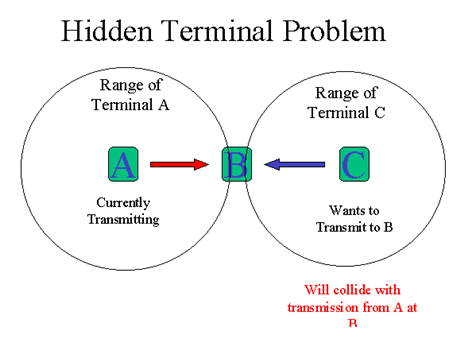
RTS-CTS Mechanism
-
the senders sends an RTS packet to the recevier including
- the intended receiver of the datapacket
-
the whole expected duration of transmission
-
RTS packet is received by all MTs in one-hop neighborhood of the sender
- they set their NAV
- NAV specifies the earliest time when the station is permitted to attempt transmission
-
The intended receiver of packet does :
- wait for SIFS
- repsonse with CTS packet
- CTS contains the duration field
-
CTS packets is received by all Mts in one-hop neightborhood of the receiver
- set NAV
- if the set of stations receiving RTS and CTS are different, hidden terminal exist.
-
All stations are informed and the medium is resreved for one sender exclusively
-
The sender starts its transmission after waiting for SIFS
-
The receiver receives packets waits for SIFS and repsonds with ACK
The NAV in each node marks the medium as free

| Shortcoming | Advantage |
|---|---|
| significant overhead and sometimes is not performed | remove the hidden terminal problem |
| Perforamnce well in overload network |
- Sometimes RTS-CTS is not performed
- depends on RTS threshold
- ”>” RTS threshold , RTS-CTS-DATA-ACK
- ”<” RTS threshold, DATA-ACK
- perform well in moderately loaded network but not in overload network
- depends on RTS threshold
Fragmentaiton and reassembly
Purpose
- to decraese the number of incorrectly received frame due to bit errors
- the length of the fragments are equal to each other within a single packet
- the length of final fragment can be less
- fragments contains information nedded to resemble the initial packet

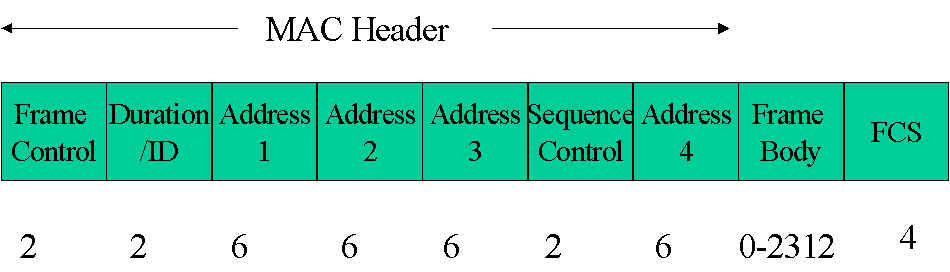
Other Mac functions
- Point Coordination Function(PCF)
- provides QoS parametres : max access delay, minimum transmission bandwidth
- Synchronization
- each statiion has a clock ,all clocks have to be sychrnoized
- Power management
- Qos in IEEE 802.11 environment
- Hybrid coordination Function (HCF)
- Support for roaming
- AP has a range of up to several hundreds metres
- when the stations begins to experience a poor single quality it scans for a new AP
Scanning Method
- Active Scanning
- sends a probe on each channel and waits for responsive
- Passive scanning
- listneing to the medium to find other networks

| IEEE 802.11b | IEEE 802.11a | IEEE 802 .11g | who wins | |
|---|---|---|---|---|
| Power efficiency | DSSS direct-sequence spread spectrum | OFDM Orthogonal frequency-division multiplexing | OFDM Orthogonal frequency-division multiplexing | 802.11b more powe efficient |
| Frequency | 2.4Ghz ISM, highly overloaded | 5Ghz,higher absorbtion rate | 2.4Ghz ISM, highly overloaded | poor performance in overloaded environment |
| Communication range | ~150m | ~50m | 50~150m | 802.11b |
| Data-rate | 11Mbps | 54Mbps | up to 54Mbps | higher than b ,lower than a |
| Cost efficiency | well-established manufacturing | components are more expensive | expensive than 802.11b, less expensive than a | 802.11b is cheaper |
| Compatibility | first | not compatible with 802.11b | compatible with 802.11b; | 802.11g is good |
| Number of users | More users, higher bandwidth and more channels | same number of channel as in 802.11b | capacity of 802.11a is higher |
System design for networking in IEEE802.11
Types of network based on IEEE 802.11
Baic Concept in 802.11 System
- Basic Service Set (BSS): a set of stations communicating with each other
- Basic Service Area(BSA): area in which stations communicate
Two modes in operation
-
Independent BSS: IBSS (Ad-hoc mode)
- MT communicates directly with other Mts with APs

-
Infrastructure BSS (Infracstruture mode)
-
MTs communicatie via AP
-
Less complex configuration
-
Ap assists station in power savings
-

- Extended Service Set (ESS)
- created by linking BSSs using backbone network
- provide larger service areas
- does not specify pariticular technology
- just requires backbone to provide a specific set of service

Components in infrastructure BSS/ESS
Compoents
- Distribution system : backbone network
- capabilities of bridging APs
- relay (接力) of frames within ESS
- Inter AP protocoal (IAPP)
- Access points
- Wireless medium
- Station
Network Services
Provided by
AP
| Network Sevices provided by AP | |
|---|---|
| Association | The address of MT must be known by AP before communication. This is done via association. |
| Reassociation | The established association is transferred from one MT to another using reassociation. |
| Disassociation | When node leaves AP or shuts down it enforces disassociation. |
| Distribution | This refers to the distribution of traffic within, in and out the network. |
| Integration | This service is evoked when transmission via non-IEEE 802.11 network is required |
MT
| Network Sevices provided by MT | |
|---|---|
| Authentication | This is used in order to establish the identity of stations to each other. Authentication implementation may range from insecure handshake procedures, to public key encryption schemes. |
| Deauthentication | terminate existing authentication |
| Privacy | The contents of messages os sometimes encrypted using a certain protocol to prevent unauthorized reading. |
| Data delivery | IEEE 802.11 networks provide a way to transmit and receive data. The transmission is not guaranteed to be completely reliable. |