Chapter 6 - 5G Cellular and New Radio
5G Cellular and New Radio
Satisying growing traffic demands
Is 4G enough
- 1000Mbps for all subscribers in a cell
- Cell radius ~500m to 2Km
- Density of users : city centre -0.1 to 0.1 humans/m2
- The traffic growth is so huge
- Performance metrics
- Shannon Channel capacity
- $C=Blog_2(1+S)$
- B is the bandwidth
- S is the SINR(signal-to-interference plus noise ratio)
- $S=\frac{P_R}{BN+I} $
- $P_R$ is the signal power at the receiver
- $N$ is the thermal noise, constant
- I is the aggregated interference
- Signal power at the receiver
- $P_r = P_TAd^{-Y}$
- $P_T$ is the emitter power at the transmier
- A is the constant that depends on antennas/frequency
- Y is the “path loss exponent” deponds on environment
- Shannon Channel capacity
- FINAL VERISON = $C=Blog_2{(1+\frac{P_R}{BN+I})}$
- PHY Layer mechanisms
- FEC,MIMO,ARQ, 90% to shannon
- Increse emitted power
- may increase interference
- Decrease thermal noise
- Constant up to 0.6Thz
- may use superconductor
- Decrease interference
- Logarithmic increase of C
- Increase bandwidth
- Almost linear increase of C
- Network Mechanisms
- Better Spatial frequency reuse
- PHY Layer mechanisms

Increasing bandwidth
- buy more licenced frequencies
- Commercial netwoks(cellular networks)
- Exclusive access
- Ablity to use higher transmission power >1mW
- High costs and risks
- Less than 100-500Mhz overall in a country(less than 3Ghz )
- Use the unlicensed spectrum
- ISM bands (Industrial, scientific, medical bands)
- Extreme interference from Wi-Fi-s
- Spectral Efficiency
- the information rate that can be transmitted over a given bandwidth in a specific communication system
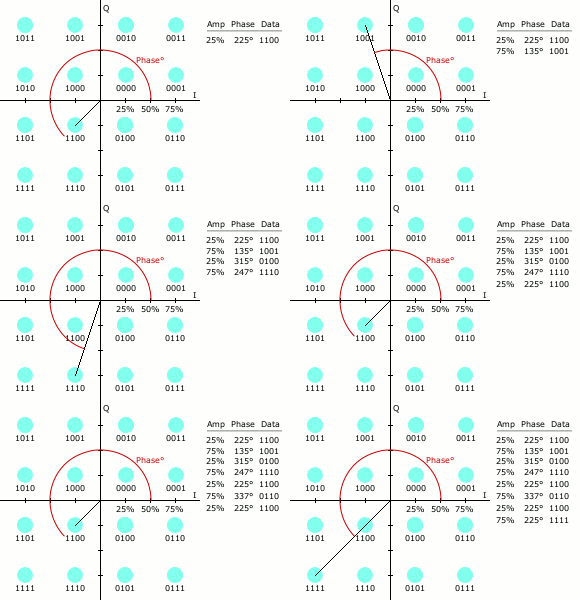
- Quadrature Amplitude Modulation
- PSK+ASK :S(t)= $Acos(wt+\phi)$, modulating $w $and $\phi$
- Higher frequency then more bandwidth available
- 5G: millimeter wave (mmWave)
- 28Ghz
- 60Ghz(802.11ad)
- 72Ghz

- Postives
- Highly directional antennas
- Negative
- Blockage by humans
- Large propagation losses
- Realistically up to 100m
- B5G,6G: teraherz(sub-mmWave)
- 275-325 GHz: 50Ghz of bandwidth
- IEEE 802.15 3d”100Gbps wireless”
- Positive
- Even more directivity
- Hugh channel capacity
- Negative
- Atmospheric absorption(大氣吸收)
- Blockage by Human
- Extreme propagation losses
- up to 10-20m realstically
5G and New Radio Interface
5G/5G+ systems as enablers
- Resembles properties of CPS
- CPS is Technological systems where physical and cyber components are tightly integrated(smartphone)
- Moves us closer to tactile Internet(觸覺互聯網) conecpt, next IoT
- Has to be supoorted by 5G/5G+ mobile cellular systems
- At least two of the following are required
- High throughput
- High reliability
- Low latency
- Reliable service over inherently unreliable medium
Envisioned 3GPP 5G services
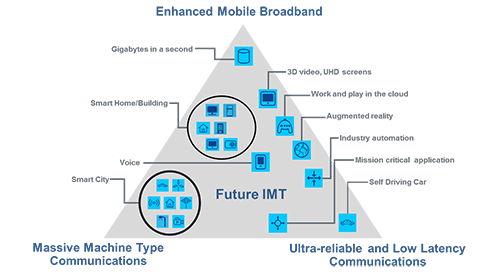
- Enhanced mobile broadband(eMBB)
- data-driven use cases requiring high data rates across a wide coverage area.
- Massive machine-type communications(mMTC)
- NB-IoT technology
- Ultra-reliable low-latency services (URLLC)
- Not yet available and no dates annouced
5G evolution or revolution
- 5G/5G+ systems are heterogeneous(同質) in nature
- New Radio(NR) RAT(28,38,72GHz)
- RAT (Radio Access Technology)
- Multi Rat support,,BT,WIFI,3G,4G,LTE
- Advanced features: D2D, relays, femto/micro BSs.
- D2D : Device to Device
- SDN/NFV capabilities for control plane
- SDN: Software Defined Networking
- NVF: Network Virtualization Function
- New Radio(NR) RAT(28,38,72GHz)
- NR is expected to support URLLC service
- delivery up to 10Gps per AP
- upper bound latency
- provide reliability
Propagation in mmWave band
- Highly complex compared to microwaves
- Multiple paths
- Material dependent
- Spatial correlation
- the channels between different antennas are often correlated and therefore the potential multi antenna gains may not always be obtainable
- Temporal correlation
Path blockage phenomenon
- Very small wavelengths
- 30Ghz ~1mm
- Cannot penetrate through objects
- Cannot travel around
- 30Ghz ~1mm
- Blockage happens at sub-second scales
- Models for various environments needed
Beam tracking(波束追蹤)
- Massive MIMO to form directional radiation patterns
- Linear arrays HPBW~102/N
-

- Positive effects
- Much less interference
- Noise-limited regime?
- Negative effects
- Beam alignment needed
- Array swtiching time ~2us
- Exhaustive vs hierarchical
- Delay and loss in capacity ?
Extreme and complex path loss

Addressing Latency
- Main chanllenge
- NR frame duration : 1ms
- Latency <1ms
- How to conform?
- Two principle ways
- Reservation/priorities
- Non-Orthogonal multiple access (NOMA)
- International overlapping of data
- Enable by flexible NR slot numberology
Addressing Reliability
- Bloackage may or may not lead to outage(中斷)
- Case 1: blockage leads to lower MSC scheme
- MSC: Mobile Switching Service Centre
- Case 2: bloackage leads to outage
- Case 1: blockage leads to lower MSC scheme
- MSC: Mobile Switching Service Centre
- Solution
- Case 1: provide more resources
- Bandwidth reservation
- Isolated deployments
- Case 2: find a new path
- 3GPP multi-connectivity
- Dense deployments
- Case 1: provide more resources