Chapter 10 - WPAN/WBANs.Zigebee
WPAN/WBANs.Zigebee.m
IEEE 802.15 WG
- Specify WPAN standard
-
Wireless Personal Area Network
- TG 1 802.15.1: WPAN/Bluetooth
- defines PHY and MAC of Bluetooth
- standard issued in 2002 and 2005
- TG 2: 802.15.2: coexistence
- coexistence of WPANs with other networks in unlicensed band;
- EEE 802.15.2-2003 published in 2003 and then ”hibernated”.(休眠)
- high rate WPAN
- 802.15.3-2003 is a MAC and PHY standard for high-rate (11 to 55 Mbit/s) WPANs;
- 802.15.3a: UWB PHY… no agreement when choosing PHY (MB-OFDM vs. DS-UWB);
- 802.15.3b-2005: improve implementation and interoperability of the MAC;
- 802.15.3b-2009: mm-wave-based PHY, 57-64Ghz unlicensed band, >2Gbps
- TG 4: Low Rate WPANs
- long battery life, low data rate, low complexity;
- 802.15.4 standard released in May 2003;
- many networks runs on top of 802.15.4: ZigBee, 6LoWPAN, WirelessHART, etc.
- Enhancements of 802.15.4
- 802.15.4a-2007: additional PHYs, e.g. UWB pulsed radio;
- 802.15.4-2006: clarification of the original standard;
- IEEE 802.15.4c: adaptation to unlicensed bands in China;
- IEEE 802.15.4d: adaptation to unlicensed bands in China;
- IEEE 802.15.4e: enhancements for industrial apps, e.g. channel hopping;
- IEEE 802.15.4f: active RFID systems;
- IEEE 802.15.4g: smart utility networks: large networks with a lot of end systems.
- TG 5 Mesh networking
- two parts: low rate and high rate mesh networks;
- low rate: IEEE 802.15.4-2006 MAC
- high rate: IEEE 802.15.3/3b MAC;
- common features: network initialization, addressing, multihop unicasting;
- low rate: multicasting, broadcasting, portability, trace route and energy saving
- two parts: low rate and high rate mesh networks;
- TG 6 Body Area Network
- low-power short range standard, draft in 2011
- TG 7: visible light communication
- work in progress
ZigBee
- developed by ZigBee Alliance
- on top of IEEE 802.15.4
- Particular implementation of those features specified in IEEE standard
- Toptology in
- Centralized star
- Cluster-tree-based
- full mesh(requires additional routing protocol)
- Specifics:
- low-rate (even compared to Bluetooth)
- extremely low power consumption
- example of applicability: sensor networks
Comparison with other technologies

IEE 802.11x technolgies
-
3x more expensive than Bluetooth
-
5x the power consumption of Bluetooth

Reason for Zigbee
- low cost, high reliability, very long battery life
- high security, self-healing properties, larger number of nodes supported
-
ease of deployment, guaranteed delivery, route optimization
- NOT CHOOSING
- Very specific apps
- BLE Exists
ZigBee application

- Wireless sensor networks
ZigBee Protocol Overview

IEEE 802.15.4 PHY
- Three low power unlicensed radios:
- 2.4Ghz: 250Kbps(EU) 16 channels (ch11-ch26);
- 915Mhz: 40Kbps(US) 10 channels(ch1 - ch10)
- 868Mhz: 20Kbps(Europe and Japan) 1 channel (ch0)
- Cahnnels and modulation in 2.4Ghz
- 16 channels , each 5Mhz wide ch 11-26
- actual throughput, 50% of 250Kbps due to overheads
- overheads: addressing, security, error control
- DSSS (direct sequence spread spectrum ) channel access
- O-QPSK modulation
- Other responsiblities of PHY
- detecting transmissions from new nodes
- assessing quality of links with other nodes
IEEE 802.15.4 MAC
- Functionlity
- CSMA/CA
- max.length of packet is 127bytes (2 bytes for CRC)
- guarantees? transmissions
- Two modes of operation
- Acknowledge
- Unacknowledge
- How ACK mode is implemented
- setting ACK bit in a forward packet
- if set: receiver ACKs correct reception
- if no: ACK is received with some time, retransmission
Device types
- FFD (Full Function Device)
- capable of all the features and always “on”
- routing/coordination/network formation
- can talk to other FFDs and RFDs
- FFDs require more power
- RFD (Reduced Function Device)
- Sometimes called leaf nodes
- simple netoworking functions
- end systems in a sensor network
- can talk to FFD only
Logical entities
| Full Function Device (FFD) | Reduced Function Device (RFD) |
|---|---|
| Found in any topology | Found only in start topology |
| Can be a network co-ordinator | Cannot be a network co-ordinator |
| Can talk to any type of device | Talks only to FFD |
| Usually main powered | Usaully battered powered |
- Network Coordinator
- FFD, one per work
- Create a network , assign channel/address
- adds new devices to a network
- constant power supply
- sometimes serves as a gateway
- a node may join if the coordinator is up
- if down, already existing node may continue to network
- Router Functionality
- FFD devices serving as a relay node
- range extension
- constant poewr suplly
- sores packets sent to sleeping nodes
- can be used to access the network
- End Device
- FFD/RFD
- low power consumption
- sleeping modes are defined
- communication through routers
Network Topologies
Star Topology

| Advantage | Disadvantage |
|---|---|
| small delay due to single hop | single point of failure(co-coodinator) |
| end devices cannot communicate directly |
Cluster-tree Topology

- two levels of hierarchy
- more nodes can be added via routers
- large coverage areas
- several paths in-between end nodes
Mesh Topology
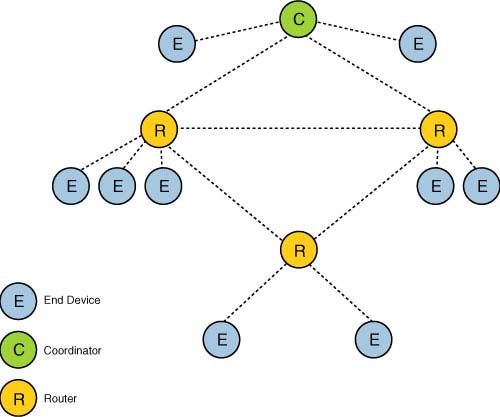
- extension of cluster-tree topology
- connections to deveices at different layer feasible
-
RFD are still unable communicate directly
- DELAY CAN BE REDUCED but COMPLEXITY of ROUTING is HIGH
Access methods
- non-beacon access
- transmit at anytime when channel is idle
- “free-for-all” environment
- beacon-based access
- coordinator generates a superframe identified at beacon time
- all nodes are synchronized
- nodes transmit only i its designated time slot
- superframe may contain common slot when stations compete
- in-between: could go sleeping
Creating a network
-
Initialization for coordinator
- a node searches for coordinators on all channels;
- if no coordinators, starts its own one using unique 16-bits PAN ID;
-
Initialization for end nodes:
- scanning all available channels;
- can detect router and coordinator with the same PAN ID
- if yes, device with strongest SNR is chosen;
- end devices sends “can i join”
- address is allocated if there is place for a new node
-
Parameters set by a coordinator:
- max number of child devices allowed per router
- max number of hops from the co-ordinator to the most distant device
###
Network Example

Addressing
- Three types of IDs
- MAC address (64-bits ID)
- network address(16-bits ID)
- name of device
Unicasting and broadcasting
- Usage of address
- while joining: extended MAC address
- while connected: short network address
- Unicast
- network address is used as destination address in MAC header
- message is routed in the network
- destination accepts the message, others drop
- destination answers with ACK
- the process is a bit more complex: local ACKs
-
Broadcasting is used when
- joining or rejoining network
- discovering routes in the network;
- should be minimized
- Broadcasting
- MAC address is 0XFFFF
- all active devices receive and analyse the message.
- all active FFD devices retransmit it
- ACKing broadcast message
- no explicit active ACKs
- passive ACKing: listening whether all neighbors retransmitted
- if not repeat the transmission

Routing and route discovery
- General consideration
- star topology no need routing
- cluster-tree and mesh topologies need routing
- more than one approach
- Cluster-tree topology
- tree-routing
- works fine for small networks
- route discovery
- work when network is unstable or large
- tree-routing
-
Mesh topology
-
route discovery is only possible with AODV
-
Tree routing
- use tree hierarchial structure
- first decision: whether to go up or down in hierarchy
- examining
- if destination is a descendant, the device sends the packet to a child;
- otherwise, send it to a parent
- upon reception by a node
- accepts if the destination is a directly connected child
- otherwise: sends to a parent
BAD: path could be longer than needed
GOOD: quite stable as tree structure is guaranteed
Sleeping modes
General facts
- reduce power consumptions
- still retain network address while sleeping
- parent device buffers packets while child is asleep
- upon wake up it checks whether there are some in store
Two types of sleeping mode
- Cyclic sleep
- additional modes : can be controled , pin sleep