Chapter 12 - Ad hoc networks
Ad hoc networks
Cellular and ad-hoc wireless networks
| Cellular networks | Ad-hoc wireless network |
|---|---|
| Fixed infrastructure | No infrastructure |
| Single-hop wireless links | Multi-hop wireless links |
| Guaranteed CBR bandwidth (voice traffic) | Shared radio channel (data traffic) |
| Initially, circuit-switched | Initially, packet-switched |
| High cost and time of deployment | Very quick and cost-effective |
| Reuse of frequency via channel reuse | Dynamic frequency sharing |
| Bandwidth reservation is achieved easily | Complex MAC layer |
| Nowadays applications: civilian, commercial | Nowadays applications: military, rescue |
| High cost of network maintenance | Maintenance operations are built-in |
| Low complexity of mobile devices | Intelligent mobile devices are required |
| Widely deployed, evolves | Still under development in commercial sector |
Application of ad-hoc wireless network
- applications
- military applications
- collaborative and distributed computing
- emergency and rescue operations
- mesh networks
- wireless sensor networks
- hybrid cellular / ad-hoc wireless networks
- why ?
- quick depolyment
- inexpensive deployment and operation
Technical challenges
Medium Access Scheme
- MAC usded for shared use of the transmission medium
- performance depends on MAC protocol
- chanllenges
- distribution operation
- maximum throughput
- minimum access delay
- fairness
- real-time trafiic support
- power control capabilities
- use of directional antennas
- hidden/exposed terminal problems
Routing
- responsible for
- determining a feasible path
- discovering, storing, and exchanging routing information
- gathering information about a path breaks and updating route information accordingly
- Challenges
- Mobility
- Bandwidth constraints
- Resource constraints
- Errorneous transmission medium
- Location-dependent contention
- requirements on a routing protocol in ad-hoc networks
- minimum route acquisition delay
- Quick route configuration
- loop-free
- distributed routing
- low overhead
- scalabiltiy
- privacy
- support for time-sensitive traffic
Multicasting
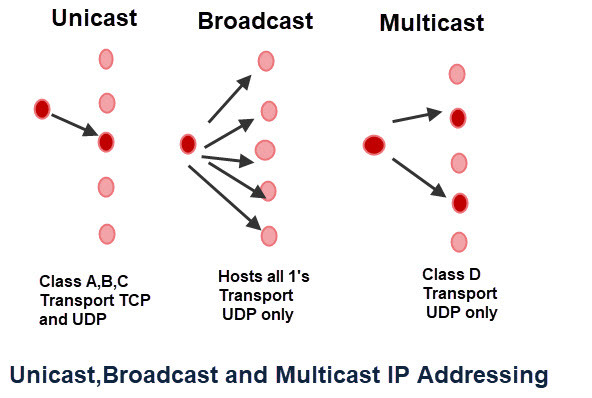
- Multicasting is an important feature in wireless ad-hoc networks:
- search and rescue operations: distribution of commands
- military applications: distribution of command
- Why not to adapt something from fixed networks (CBT, PIM, DVMRP)
- core base trees (CBT), distance vector multicast routing protocol (DVMRP), etc.
- mobility of nodes changes the topology of the network! Trees are unstable!
- There are following challenges in ad-hoc environment for multicasting:
- Fast recovery;
- Control overhead;
- Efficient group management;
- Scalability;
- Security.
Transport Layer Protocol
- Major function of connection-based transport layer protocol:
- setting up and maintaining end-to-end connection
- reliable end-to-end delivery of data packets
- flow control
- congestion control
- Why not to go with UDP
- does not perform flow and congestion control and reliable end-to-end transfer;
- Performance degradation stems from
- high error rate
- frequent path breaks
- presence of ‘old’ routing information
- network partitioning
Quality of Service provisioning
- QoS
- traffic performance in the network
- service support performance
- service operability performance
- service security performance
- To satisfy QoS
- use values of traffic engineering variables that constitute the so-called Grade of Service (GoS)
- Provision of QoS requires:
- negotiation between the host and a network
- resource reservation schemes
- priority scheduling
- call admission control
Self-organization
- Self-organization is the main attractive property of ad-hoc networks.
- To perform self-organization the following things are required:
- neighbour discovery
- first phase when a node switches on;
- a node should gather network information (transmission of reception of discovery packets).
- topology organization
- every nodes gathers information about the entire network (a part of);
- construct and maintain the network topology.
- topology reorganization
- when links break, nodes switch off etc
- requires periodic or aperiodic exchange of topology information.
- neighbour discovery
Security
- Ad hoc are more vlunerable to attacks because
- lack of central coordination
- shared wireless medium
- Two types of attacks
- passive attacks
- malicious nodes attempt to obtain information relayed in the network;
- no damage to operation of the network, just capture if information
- active attacks
- external attacks: attacks executed by nodes outside the network;
- internal attacks: attacks executed by nodes belonging to the same network.
- passive attacks
- Denial of Service
- Resource consumption
- Energy Depletion
- to deplete the power of the node relaying the traffic through them.
- Buffer overflow
- fill the routing table with ’bad’ entries to consume the buffer space of the target node.
- Energy Depletion
- Host impersonalization
- Infomration disclosure
- Interference
Addressing and service discovery
- Addresses
- Global unique address
- autoconfiguration of address
- Duplicate address detection mechanism
- Meaningful features for ad-hoc network
- automatic service advertisement mechanism
- should allow to identify the current location of the service
- it is not possible to assume static service locations in ad hoc networks.
- integration of service discovery protocols and routing protocols
- may allow to easily find the necessary service in a networ
- may violate the traditional design objectives of the routing protocol
- automatic service advertisement mechanism
Energy management
- can be done
- shaping the energy discharge pattern
- use routes with minimal total energy consumption
- use special task scheduling schemes
- proper handling the processor and interface devices
- can be achieved by
- Transmission power management
- Battery energy management
- Processor power management
- Interface power management
Scalability
- Testbeds and operational ad hoc networks made so far:
- contain only a limited number of nodes
- may not be good examples of ad hoc performance
- What we may expect in real implementations
- performance of ad-hoc network degrades drastically with the increase of the number of nodes
- one may expect commercial realization of, at least, thousands of nodes
Deployment
- Low cost : no cables, no configuration, no maintenance
- Incremental : functioning starts immediately after minimum configuration is done
- short time : no cables, no configuration, no maintenance
- reconfigurability : no cables, no configuration, no maintenance
Example : data-link/network/transport
Data-link layer MACA
- MACA:
- stands for MAC protocol for ad hoc networks.
-
major facts
- contention-based without reservation and scheduling
- MACA was prposed as an extension for CSMA/CA protocol
- was further extended and adopted for IEEE 802.11
- CSMA
- the sender sense the channel for the carrier signal;
- if the carrier is present it retries to sense the channel after some time (exp. back-off);
- if not, the sender transmits a packet
- Shortcoming for CSMA/CA
- hidden terminal problem leading to frequent collisions;
- exposed terminal problem leading to worse bandwidth utilization
MACA avoids hidden and exposed terminal problems using the RTS-CTS.

- RTS and CTS packets carry the expected duration of transmission;
- a node near the sender
- that hearing RTS do not transmit for a time to receive CTS;
- a node near the receiver
- after hearing CTS differs its transmission
- if the neighbor hears the RTS only
- it is free to transmit
Network layer: Location Aided routing (LAR)
- use the location information
-
reactive protocol
- Two zones
- Expected Zone
- a geographical zone in which the location of the terminal is predicted based on:
- location of the terminal in the past
- mobility information of the terminal
- a geographical zone in which the location of the terminal is predicted based on:
- Request Zone
- a geographical zone within which control packets are allowed to propagate
- area is determined by the sender of the data packet
- control packets are forwarded by node within a RequestZone only
- if the node is not found using the first RequestZone, the size of RequestZone is increased.
- a geographical zone within which control packets are allowed to propagate
- Expected Zone
- Nodes decide whether to forward or discard packets based on two algorithms:
- LAR type 1
- LAR type 2
- LAR type 1


Transport-layer protocols: Split TCP
- TCP major problems
- degradation of throughput with increase of path length
- unfairness among TCP flows
- degradation of throughput with increase of path length
- split-tcp provides the solution by splitting the TCP functionality into two part
- congestion control
- local phenomenon due to high contention for resources
- end-to-reliability
- end-to-end phenomenon
- congestion control


Split TCP:
- splits the connection into a set of concatenated TCP connections
- proxy node
- terminating the connection from the sender/precessor proxy node;
- setting up a connection with receiver/successor node.
- are chosen using the distributed algorithm
- packet traversed n hops - behave as a proxy
- Transmission control at the TCP sender window is split
- end-to-end CW
- updated according to arrival of end-to-end ACKs
- local CW: (local CW ≤ end-to-end CW)
- updated according to arrival of local ACKs (LACKs) from the next node.
- end-to-end CW
- Proxy node behaves
- it maintains local CW governing transmission in a segment;
- when packet arrives from predecessor the LACK is sent back;
-
arrived packet is buffered;
- the buffered packet is forwarded to the next node.

