Chapter 99 - Question Revision
Spread Spectrum
- Spread-spectrum is designed to trade bandwidth efficiency for reliability, integrity, and security
- FHSS
- Frequency Hopping Spread Spectrum
- Spectrum is divided into many subchannels
- two communicating systems hop on same frequency
- DSSS
- Direct Sequence spread spectrum
- stations are assigned orthogonal codes
- use these code for transmission
- other stations transmissions appears an noise
- Direct Sequence spread spectrum

ARQ
- Automatic Repeat reQuest
- Reactive protocol
- control protocols for transmission of data over noisy or unreliable communication network.
- Use ACK and timeouts to acheive reliable data transmission
- Stop-and-wait ARQ, Go-Back-N ARQ
Aloha VS slotted Aloha
- Aloha
- a terminal transmits whenever the user data is ready
- if the sender finds that the packet get collided
- it waits for a random period of time
- send the packet again
- Throughput : $S_{pure} = Ge^{-2G}$
- Slot-Aloha
- time is slotted
- length on the slot is the time to transmit a packet
- node starts transmission in the beginning of the slots only
- if collision occurs
- sender waits for a random number of slots
- transmit Packets agains
- Throughput: $S_{slotted} = Ge^{-G}$

Why does IEEE standardize only two lower layers for WLANs
- only standardize PHY and MAC lyaer
- Interfaces to higher layer is the same as those in iEEE 80.2x standards
- The upper layers is still the same as normal LAN
- what the different is the medium for tranmission , it is in wireless now.
BEB works in IEEE 802.11 WLAN.
- Binary Exponential Backoff
- When multiple entities attempt to gain access to a shared resource, only one of them will succeed.
- Those who fail wait til the resoure becomes available then retry.
- Binary Exponential Backoff (BEB) is an algorithm to determine how long entities should backoff before they retry.
- With every unsuccessful attempt, the maximum backoff interval is doubled.
- BEB prevents congestion and reduces the probability of entities requesting access at the same time,
Why RTS-CTS needed
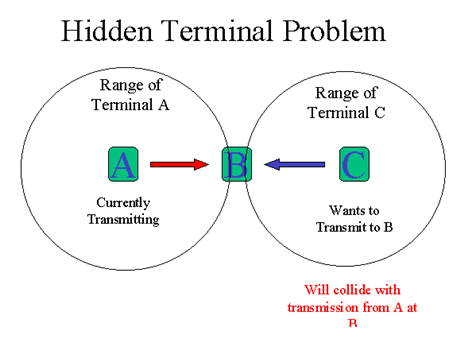
- to solve hidden terminal problem
-
hidden terminal problem occurs when a node can communicate with a wireless access point (AP), but cannot directly communicate with other nodes that are communicating with that AP.
-
RTS-CTS
- the senders A sends RTS to receiver B
- once the receiver B get RTS, it starts to send CTS to all other terminals, indicating that sender A is going to communicate with receiver B. After the this handshake, they can start send data.
Network allocation vector
- Shared Medium Access
- Carrier Sensing
- Virtual Carrier Sensing
- provided by the Network Allocation Vector (NAV)
- NAV Indicates how long the medium is reserved
- NAV is set acccrdoing to fields (Duration ) indicated in most frames
- Virtual Carrier Sensing
- Carrier Sensing
- It is a virtual carrier sensing mechanism.
- The station listens to duration field to set their NAV
- It is a indicator for a station on how long it must defer from accessing the medium
ESS and Infrastruture BSS difference
Basic Service Set (BSS) : a set of stations communicating with each other
Extended Service Set (ESS): linking BSS using backbone network
Infrastructure BSS (Infracstruture mode)
- Terminals communicate via AP
- centralized

Extended Service Set (ESS):
- provide larger service areas
- does not specify pariticular technology
- requires backbone to provide a specific set of service
Bluetooth topology


- Piconet
- master and slaves architecture
- maximum up to 7 slaves
- scatternet
- a group of piconet
Main Appilcation of ZigBee
-
Low Data-rate radio services
-
Remote control,
-
Joystick
-
Personal Health care
-
sensors

-
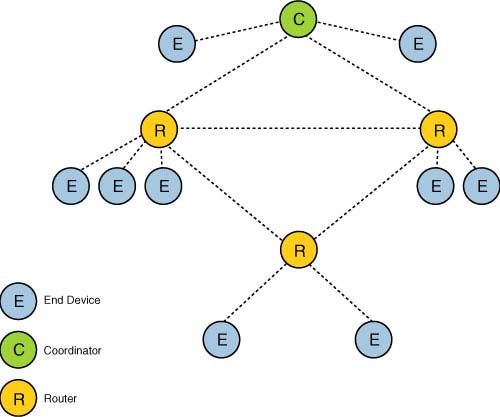
ZigBee Mesh Topology
MIssion of 3gpp
-
The 3rd Generation Partnership Project (3GPP)
-
developing globally acceptable specifications for third generation (3G) mobile systems.
shortcomings of CSMA/CD in wireless networks
- collisions in wirerless channels are harder to detect
- colisions leads to usage of bandwidth which is scarce
Which layers IEEE 802.11 specify in their standards? Why?
- only standardize PHY and MAC lyaer
- Interfaces to higher layer is the same as those in iEEE 802.x standards
- The upper layers is still the same as normal LAN
- what the different is the medium for tranmission , it is in wireless now.
What are two principle operation modes of 802.11a/b/g/n systems?
- ad-hoc mode
- infrastructure mode
Briefly explain evolution of air interface technology from GSM towards LTE.
GSM
- TDMA and CDMA
- FSK digital modulation
GPRS
EDGE
- Why is ad-hoc networking useful in militaristic applications?